On spring, death, deflation, turmoil...and the necessary act of planting a seed anyway.
On Thursday morning, I almost didn’t see them.
Our brooder box sits in a half-gutted utility room just off my home office - one of many unfinished rooms in this house, one of many unfinished projects in this life, one of many things quietly accumulating the weight of intention and obligation without resolution or reward. I’d gone in before dawn to check on the fifteen Easter Egger chicks that arrived on Wednesday morning. They were barely a day old, improbably small, and already doing that thing that new chicks do where they sleep so hard they look dead…and then explode back into motion the moment the light changes.
Except three of them didn’t explode back into anything.
They were so…flat. That’s the word that keeps coming back to me, the only word that’s accurate: flat. Not still. Not peaceful. Flat - as though whatever had animated them was removed so completely that what remained wasn’t even really a body so much as an impression of one. They’d almost blended into the brooder bedding in the semi-dark. If I hadn’t counted their fluffy little siblings zooming around the rest of the box and come up with only twelve no matter how many increasingly frantic times I counted, I might not have noticed them. The living chicks stepped around them (and on them) with the cheerful or distracted indifference that only the very young & the very animal can manage. I stood there, neither cheerful nor distracted, in a half-gutted room full of the spring scent of wet potting soil and warm animals, slowly becoming aware of the unfolding sunrise…looking at three tiny, flattened husks, trying to locate my feelings about what I was seeing and muster the will to do something about it.
I’ve raised chicks before. Last June we brooded the two dozen Barred Rock hens we have now - the ones whose brown eggs my neighbors have come to count on. Those all made it. I didn’t know until Thursday morning that I had been carrying the assumption that they always do.
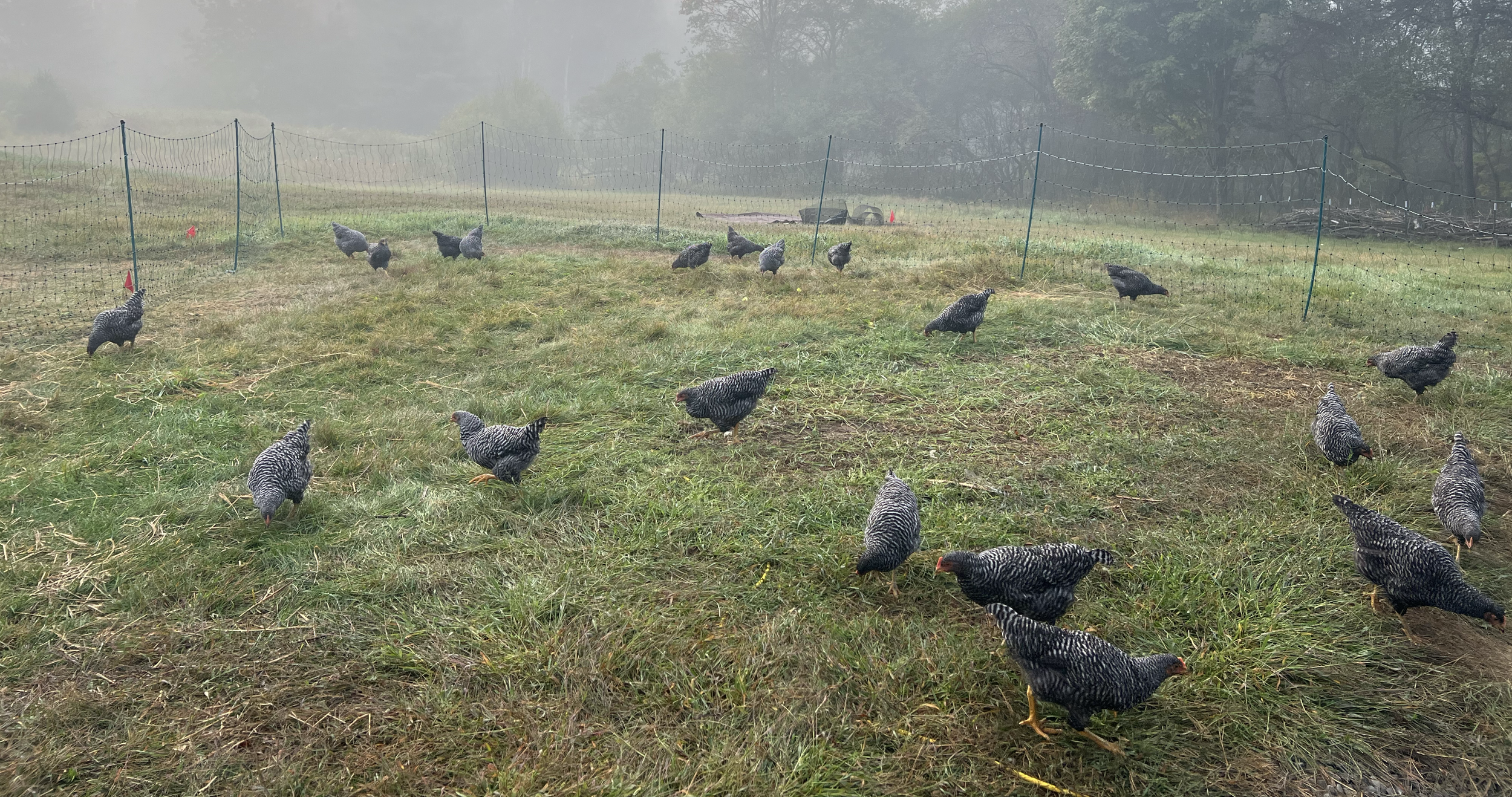
Part of our flock of Barred Rock hens (and Roo Paul) out foraging in the morning fog last summer. We started with 26 chicks and they all survived to adulthood.
I’m no stranger to death but I’ve never lost a chick before, and it broke something open in me that I hadn’t realized was sealed.
Here’s what they don’t tell you about farming - or rather, here’s what they do tell you, but in a way that makes it sound manageable, almost philosophical, & definitely stoic: death is part of it. And that’s true. I knew it was true before I started. I said it out loud to my husband when we decided to keep laying hens. I say it often. I believed it. I still do. I always will. If you want the life part of farming, the death part is unavoidable.
What I didn’t understand is that knowing something is part of it doesn’t make it feel like less. It doesn’t feel smaller, or easier (at least not to me). It just means you don’t get to be surprised. You lose the chick AND you lose the right to act like you didn’t know this was possible. Grief without the alibi of ignorance is a particular kind of lonely - one that I’ve never encountered until I started farming.
So now, every morning since Thursday and twice at night, I say “stay fluffy” to the remaining twelve chicks before I go to bed each night. “Don’t be flat. Nobody gets to be flat. Stay fluffy.” I know how stupid this sounds. I don’t care. It feels equal parts tender and desperate - the way most prayers do, if we’re honest about what prayer actually is.
Spring, if you don’t work the land, is uncomplicated abundance. The light comes back. Things bloom. The farmers market reappears. You take a walk and everything smells like something worth smelling twice. Your spirit is thawing. The sun hits your face and you feel like you took a party drug - everything is beautiful and groovy and we’re all connected, man. It is, by nearly universal agreement, the season of hope - the season that makes the argument that the world is essentially going to be ok.
If you do work the land, spring is all of that AND something else entirely: a sustained confrontation with how thin the membrane is between life and death, between enough and not enough, between the seed going in and the seed coming up. You hold both at once - the beauty and the precarity - and you don’t get to choose which one to look at.
This spring, I’ll be honest with you: the membrane feels thinner than usual.
And it’s not just the chicks.
It’s the cost of a bag of groceries. It’s watching Congress stand by while one man with a narcissist’s appetite for power and an oligarch’s indifference to consequence dismantles, piece by piece, the systems that were supposed to protect the rest of us. It’s war in the Middle East. It’s the economy doing what economies do when people who’ve never worried about money make decisions for people who always have. It’s the specific exhaustion of having worked so hard for so long and arriving at this spring with the quiet, grinding fear that it might not be enough - that we might not be able to call this farm home next year, or maybe we will…but what about the year after that?
Some years, I look at my seedlings with excitement. This year, I look at them with something that feels more like pleading. Please work, I think. Please, please work. Because otherwise we may not have much to eat.
To plant a seed is to hope. That’s the thing people say, and I believe it, and I’m planting the seeds in spite of it all. But I want to be truthful with you about what hope feels like from the inside this particular spring: it feels less like optimism and more like stubbornness or exhausted obligation. It feels less like faith and more like the refusal to stop moving even when every reasonable part of me wants to lie down flat. But regardless of the reason, the seeds must be planted. The chicks must be tended, and live. There is something simultaneously heavy and magical about the way having something rely on you for its life gets you out of bed in the morning when every molecule of your body - especially the ones in your brain and heart - cry otherwise.
Time has gone strange on me. You know that adage - the days are long but the years are short? This spring, it’s more granular than that. Sometimes an hour is three minutes long. Sometimes a week simply will not end. Sometimes I look up from work and it’s 6pm and I’ve finished maybe half of what the day required and it’s already time to make dinner, to stop, to concede the day and hope that tomorrow holds more capacity than this one did. The complexity of the season makes time feel thick and slow while I’m inside it, and then suddenly I’m blinking and a month has gone.
The chicks don’t care what day it is. The seedlings don’t either. The iris and lily bulbs have been in the ground all winter doing whatever bulbs do in the dark, entirely indifferent to the news cycle, and they will come up or they won’t based on factors that have nothing to do with war or executive orders or the price of diesel.
There is, I’ll admit, something clarifying about that.
Not comforting, exactly. But clarifying.
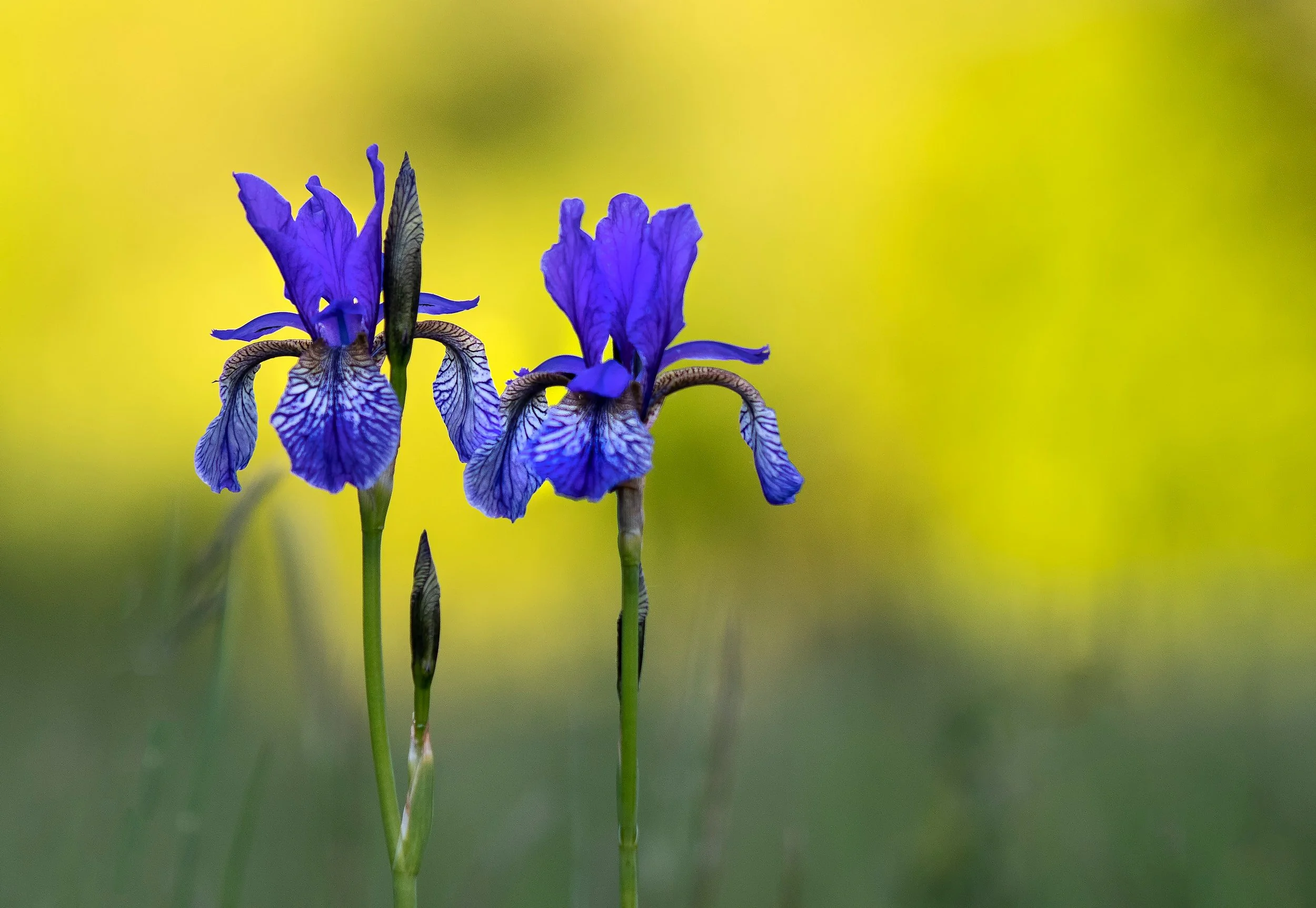
They know nothing of the things that keep us up at night. Sometimes, it feels good to look at them and lose myself in that knowledge, even just for a moment.
Wendell Berry has a poem called “The Sycamore”. It’s about an old tree in his place, shaped by his place, that has absorbed decades of damage: fences tied to it, nails driven in, lightning strikes, hacks & whittles. There is a hollow in it, he writes, that is its death - and yet its living brims whitely at the lip of the darkness and flows outward. The tree has gathered all its accidents into its purpose. It has become, Berry says, the intention and radiance of its dark fate.
I have read that poem maybe a dozen times in the last month. I keep coming back to the phrase gathered all accidents into its purpose - this idea that the damage isn’t separate from the tree’s life but woven into it, shaped by it, survived and incorporated and eventually, somehow, part of what makes the tree itself.
I don’t know if I’m there yet. Actually, I know damn well that I’m not. I think I’m still in the part where the lightning has just struck. But I keep the poem close. I am seeking the version of myself that is the sycamore because that’s who I need to be in this time. That is, for now, the version of ourselves that we all need to be.
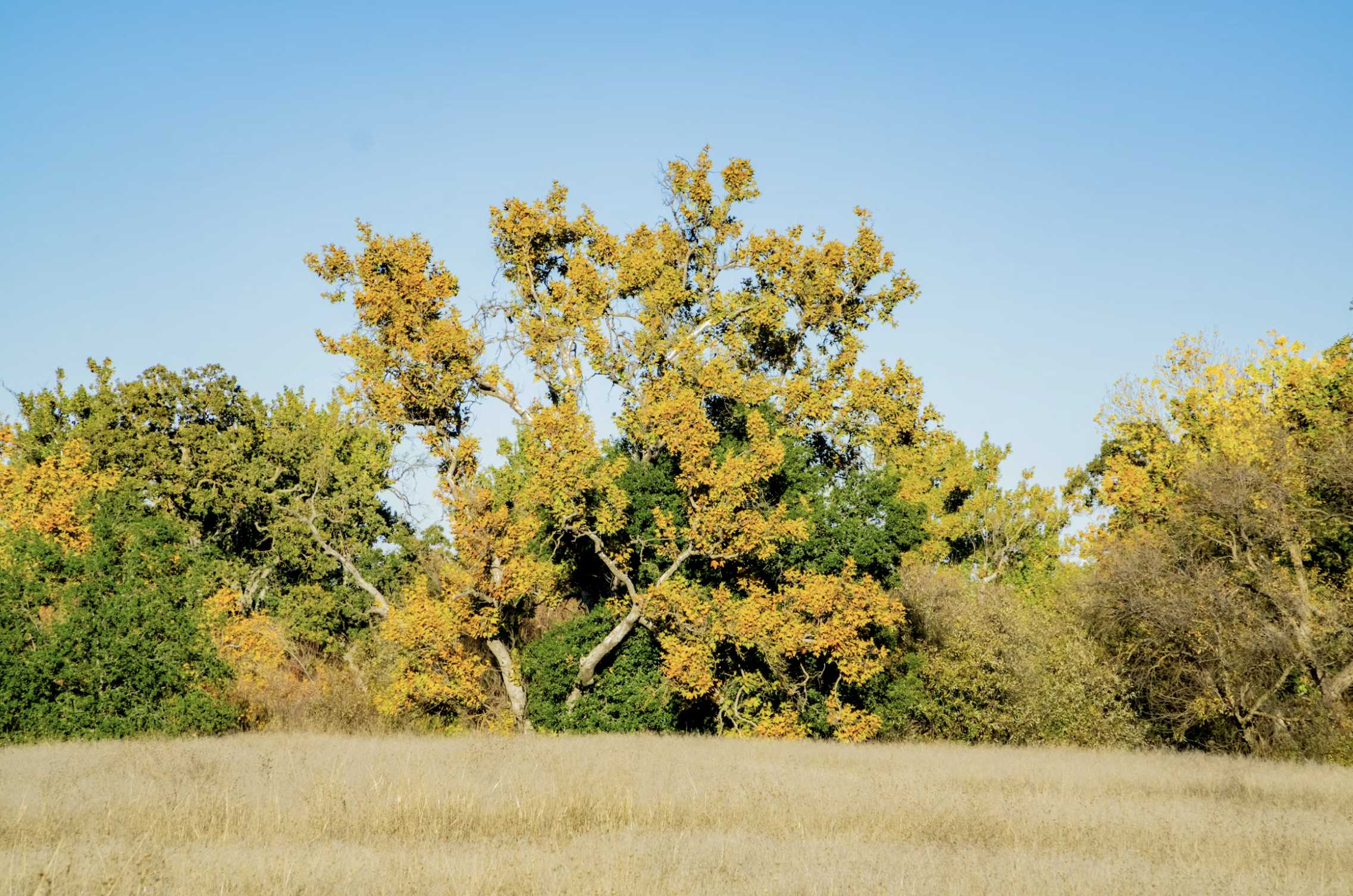
I can only guess at what has nourished and attacked this tree in its long life but for certain, all of those things are equal parts of it.
The twelve remaining Easter Egger chicks are doing well, as of this writing (despite one aggressive little smöl bean who cheeps nonstop at top volume from her temporary prison - her brand of violence cannot be tolerated in a flock, so let’s hope she learns).
The chicks are are improbably, gloriously fluffy in the way only very young chicks can be, the kind of fluffy that seems almost satirical, like the universe overcompensating. They all peep at a volume disproportionate to their size. They pile on top of each other and then explode apart and then pile again.
They have, as of yet, no idea what they are for or what the world is like or what it costs to keep anything alive in it.
The remaining, living, gloriously fluffy baby Easter Egger chicks in the brooder.
I find I am very glad to have them. If I stare at them long enough, I can disappear into their simplicity, their zooming joy, their blissful ignorance.
Every night before I go to bed, I make one last visit to the brooder box.
I look in at the small warm heap of life, still breathing, still here, peeping contentedly, and I say to them what I always say now:
Stay fluffy, little ones.
And then I say it to myself.
And now I’m saying it to you, because I suspect some of you - maybe more of you than usual this particular spring - could really stand to hear the reminder.
The world is doing what it’s doing.
The work is what it is; that list will swell and dwindle but never clear. That has always been true; it will always be true.
The membrane between enough and not enough is thin, and some days it feels nearly transparent.
Plant your seeds anyway - you must.
Tend the small living things - you must.
Gather the accidents into your purpose - or try to - and keep trying. You must.
Stay fluffy, friends.
Stay fluffy.