Hint: it's not more tradwife influencers cosplaying at self-sufficiency. It's the rest of us. Here's what you can do TODAY - and how I personally hope to help.
The American agrarian imagination is being held hostage by women in linen aprons, men with unblemished Carhartt workwear, and a glossy lie about what self-sufficiency and ideal rural culture should look like.
Scroll long enough and the pattern becomes impossible to miss. The food is so fresh you can almost smell it through your screen. The homes and gardens are gorgeous backdrops for perfectly-coiffed barefoot women in modest crepe clothing. The babies are alabaster pink. The pantry shelves are full, the appliances are haute, and the kitchen is rustic - but aesthetically so.
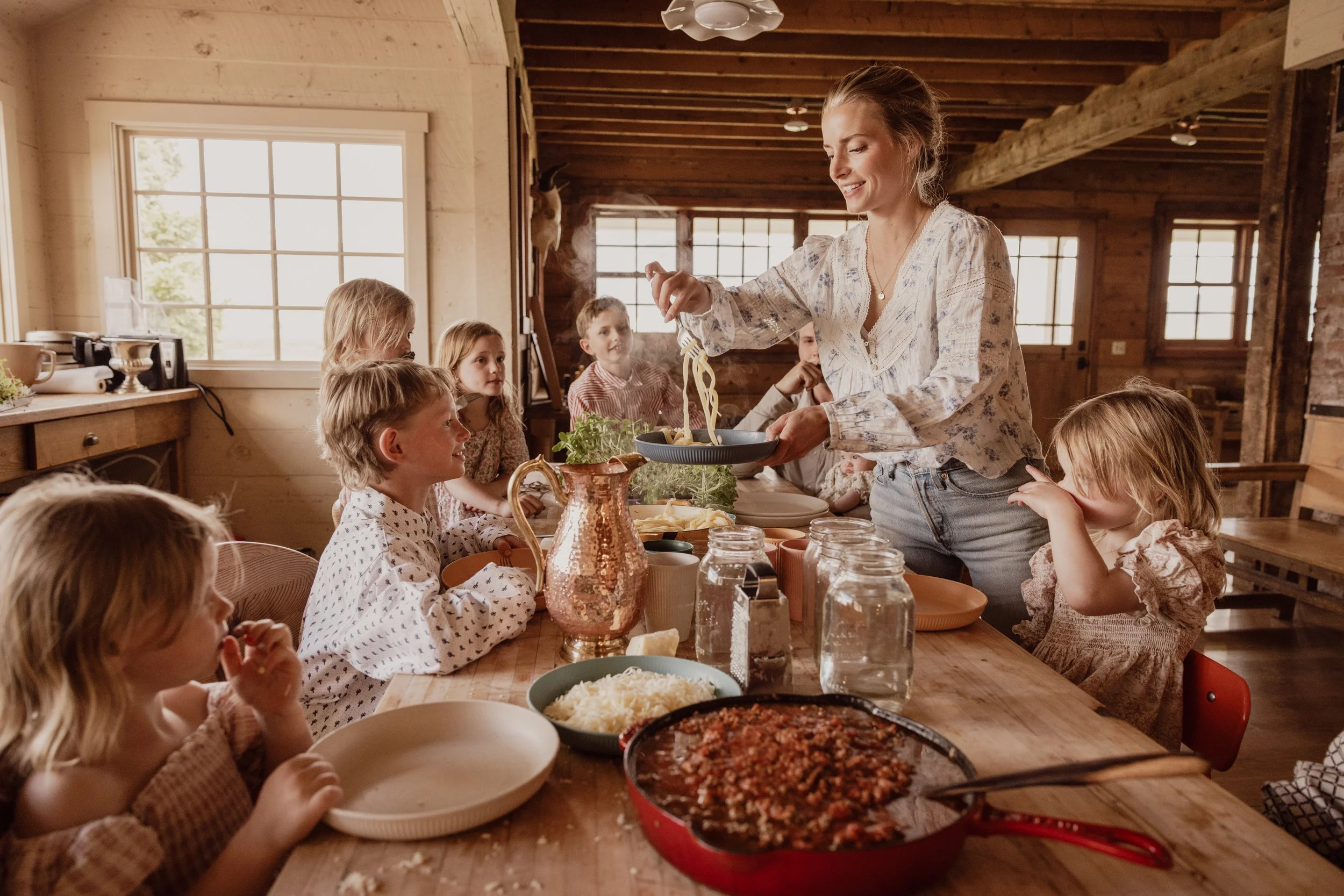
Hannah Neeleman of Ballerina Farm feeding her eight children as husband Daniel lurks in the background. The 34-year-old Mormon and Utah resident is one of the best-known influencers in tradwife culture. [Image credit: Corey Arnold of The Sunday Times Magazine]
But what is it all hiding? Or perhaps more importantly, what is it signaling? Underneath all this soft-focus domestic competence theater is a worldview that is anti-feminist, anti-BIPOC, anti-queer, anti-science, ahistorical, and profoundly unserious about what it actually takes to build a life around land, food, labor, and community… when you’re not a born-and-raised multimillionaire.
The problem is not just that tradwife influencers are irritating inventions of the conservative male imagination (though most of them are); the deeper problem is that they have become some of the most visible ambassadors for agrarian culture in America at the exact moment when more people are hungry for practical skills, local resilience, and ways of living that feel less brittle, less lonely, and less dependent on systems that are visibly failing us.
That should alarm us.
Why? Because if the loudest voices of “self-sufficiency” are steeped in evangelical Christian moralizing, pseudoscience, 1% economics, whitewashed history, and gender hierarchy dressed up as wholesome living, then we are not just losing an aesthetic battle. We are losing cultural territory that never should have belonged to them in the first place.
I think a lot of us are tired of watching that happen. I know I am.
Lately, I’ve spent a lot of time yapping online about the future of food, especially as it relates to Trump, fascism, world war, oil, and the rapid loss of farmer-owned agricultural land in the U.S. At the same time, I’ve been watching the tradfolks of the internet pave the way to a lonelier, shallower, economically-unattainable, ideologically-warped version of American agrarian life. If you spend any real time in homesteading, gardening, or farming spaces online, you already know the vibe I’m talking about. The aesthetics are always lovely; the politics are almost always awful.
Then there’s the other problem. Even when the politics of online agrarian spaces are not overtly gross, the culture can still be exhausting. Everything is optimized, polished, perfect, performative - the opposite of our daily experience as people who work with dirt and animals, essentially. Everything is either a $500 video course that leaves you feeling lonely and minimally smarter, a feed full of ads, a comment section full of trolls & bots, or a performance of competence so polished that nobody feels allowed to learn out loud anymore. (As a professional learning designer, this drives me nuts, as you might imagine.)
Meanwhile, a lot of us are over here trying to do something much more ordinary, much more human, much more fulfilling, and much more meaningful.
We are trying to grow food. Raise animals. Learn old skills in new ways. Connect with real people. Preserve what matters. Build households and businesses and neighborhoods and whole towns that can bend without breaking. Figure out what resilience actually looks like when you are not roleplaying collapse in a tactical vest or pretending your “heirloom” apron is a political philosophy.
We are trying to build lives around land, labor, food, stewardship, and community.
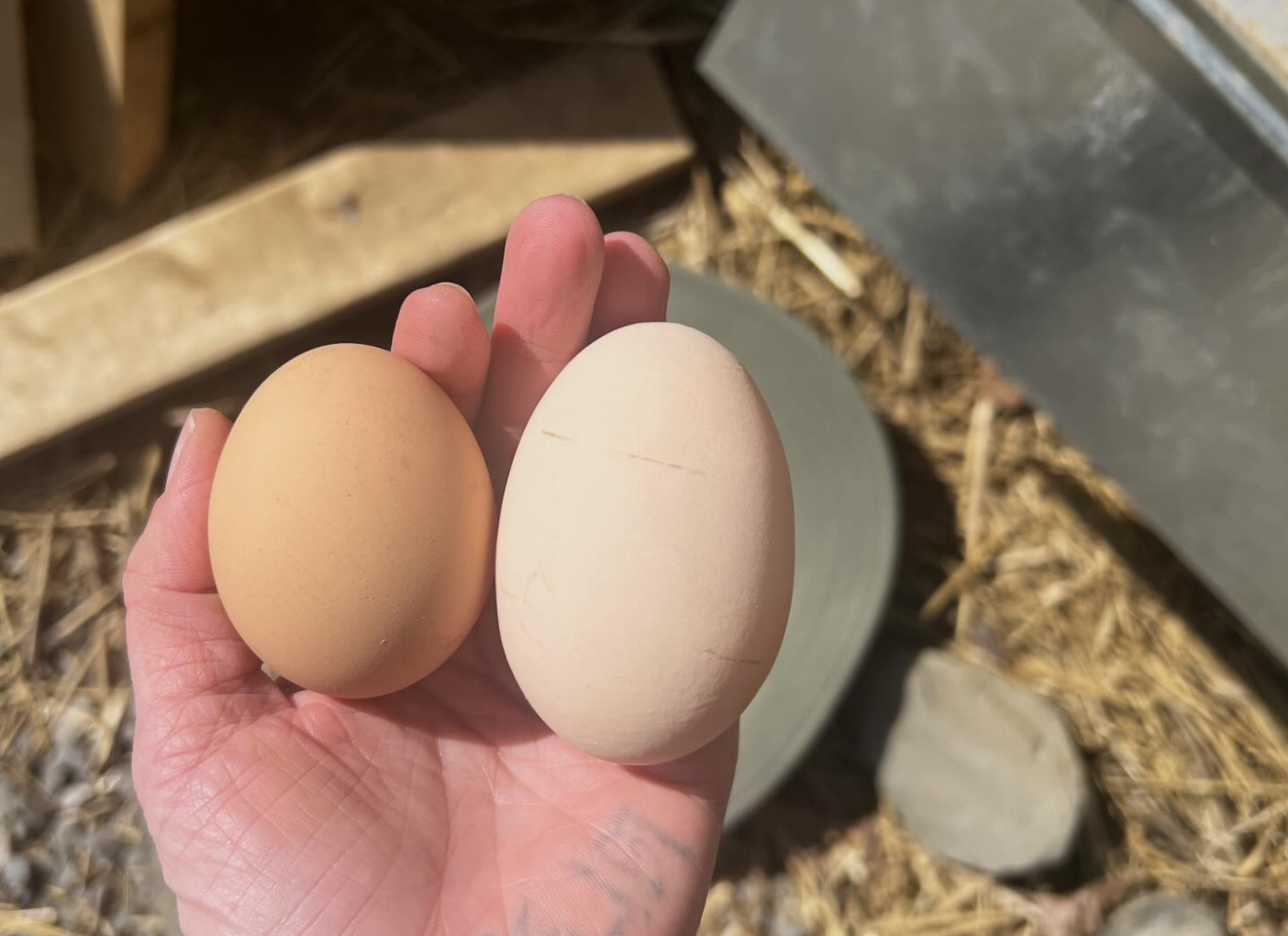
Glamorous? No. Useful, purposeful, meaningful, and resilient? YES.
Many of us - more than the conservative imagination can fathom - are trying to do these things while also being liberal or leftist, queer, anti-racist, feminist, pro-science, anti-fascist, conscious of Indigenous legacy, and ecologically serious. And we are deeply uninterested in swallowing a bunch of alt-right or evangelical baggage just to learn about seed starting or pasture management.
This combination is not rare. If you’re reading this, chances are good that YOU are nodding your head because that description above fits you to a T. We exist - it’s just that our culture - our movement - hasn’t benefited from the same kind of innate social infrastructure (i.e., churches and famous right-wing podcast bros) as the trad movement. That combination of built-in social organization + dominance of airwaves is potent.
Another part of what makes tradwife culture so effective is that the women at the center of it are not always simple villains. If they were, they’d be easier to dismiss. But some are true believers. Some are savvy entrepreneurs. Some are both. Some seem like they climbed aboard a big fantasy and found themselves trapped inside a much larger, faster-moving vehicle than they bargained for. That does not make the ideology they represent less harmful - but it does make it harder (and all the more important) to talk about.
Tradwife culture doesn’t only sell female submission. It also sells beauty, purpose, tenderness, rhythm, slowness, competence, family, and a longing to be held by a life that feels meaningful - in essence, all the things capitalism doesn’t want us to have unless we can pay handsomely for it. It also sells the aura of being a “girl boss” (to everyone but your husband, anyway) - but without the corporate trappings of “hustle culture” that so many of us have been tricked and trapped into worshipping. The true cultural danger of tradwife identity is that it packages very real, very understandable human needs and desires inside a structure built on inequality, fascism, submission, & silence.
That is why this whole issue matters more than internet snark - it has real philosophical merit. Tradwives are archetypal forms whose substance is built on valid human needs & desires…but whose shape has been molded by a malignant sculptor.
Women are not stupid for wanting a slower life. They are not stupid for wanting family, gardens, chickens, beauty, devotion, craft, competence, ritual, or a place that feels like home. They are not stupid for wanting an escape hatch from late-capitalist fragmentation, corporate alienation, hustle culture, or dead-eyed loneliness caused by a life lived largely online. Those desires are real, and valid…but our desires deserve better cultural representation than living, breathing, bread-baking propaganda machines. But if we do not personally build better and more visible models for our desires and values, then the worst people will continue to own this cultural space.
I think this is part of why so many people interested in agrarian life feel weirdly unmoored. You can piece together a version of community from podcasts, newsletters, social media mutuals, DMs, local classes, scattered conferences, and the occasional person in your town who is not secretly trying to convert you into a Christian nationalist sourdough wife. And sometimes that patchwork is genuinely wonderful - I do not want to dismiss that. A lot of us have learned a great deal from these scraps of whole wisdom and side doors into community (myself included).
But scraps and side doors are not the same thing as a robust, helpful, supportive cultural home base…and for people trying to build a life around food, land, skill, community, and resilience, that difference matters.
Why?
Because learning is easier when it is social.
Because people are more likely to keep going when they’re not isolated.
Because asking complex questions requires somewhere safe to ask them.
Because the internet is full of people who are happy to get rich on your aspirations, but much thinner on places that can actually support your growth.
Because there is a huge difference between content and community, and an equally huge difference between audience and peers.
A lot of what is missing right now is not information. There’s information everywhere - a scary amount of it, actually. The problem is that information without context, relationships, trust, and ongoing exchange has a way of becoming either entertainment, escapism, or overwhelm. Most of us have too much of all of those already.
That’s part of why even very smart, very motivated people can still feel stuck and then spiral into hopelessness (ask me how I know, friends).
And there is another piece of this that I think is worth saying plainly: the political right has spent years building a sticky, highly visible culture around self-sufficiency, “traditional life,” collapse preparedness, and homesteading. They showed up early. They showed up loudly. They built aesthetics, storylines, aspiration, and identity around these things. And because they did, a lot of people now unconsciously read agrarian life as culturally belonging to the right…especially the alt-right.
It doesn’t.
But if the most visible doorway into agrarian life keeps being an aesthetically seductive, gendered, deeply unequal fantasy, then people who are hungry for something real will keep being asked to pass through that web of propaganda before they can get to the knowledge they seek…and some of them might get caught there.
I am tired of this. It has to change.
I am tired of watching agrarian life get turned into a gateway drug for misogyny, bigotry, anti-scientific thinking, resource hoarding, Quiverfull vibes, fake history, and fashion statements masquerading as wisdom and ethics.
I am tired of seeing genuinely useful skills bundled with harmful philosophies like anti-queer politics, bootstrap mythology, and a version of “self-reliance” that leans heavily on denial, silence, and women’s unpaid labor.
I am tired of how often farmers, homesteaders, gardeners, and aspiring agrarians have to make the same grim trade: put up with all the right-wing garbage, or go without the continuity and connection that make this work actually viable.
What’s really gotten under my skin, though, is simpler than that (though no easier to bear): so many of us have been figuring this out alone, and going it alone. (Anne of All Trades has a great YouTube video about this.) Even if you farm with family; even if you homestead and have a spouse; even if your friends admire your abundant garden…it can still feel isolating when you don’t have a support squad.
That absence has been bothering me for a long time. I feel it even here, in a deeply blue state, surrounded by friends who understand what it takes to grow food and raise animals. The loneliness of being a liberal or leftist agrarian is not total - it is more specific. It comes from knowing there are other people like you out there but still not having a cohesive place to connect with them. I think (and hope) that we are on the cusp of momentous change in the liberal/leftist agrarian community if only we would realize that we are all part of a culture whose history is still being written - and it needs each of us to rise up and reach out in service of this moment.
For many months now, I’ve been wishing for a space where practical agrarian learning, political sanity/safety, social connection, and good ethics existed together. I love Threads but a social media feed won’t do it for me; nor will a YouTube comment section; nor would another overproduced online course where everyone is technically “together” but nobody is really there. I’ve been craving something with enough life in it to hold beginners, elders, urban farmers, commercial growers, budding farmsteaders, damn-near-jaded homesteaders…and even the people who are still trying to figure out whether this way of life is even possible for them.
I wanted a place where a person could ask a question without getting smacked with contempt (as we so often see online). I wanted somewhere people could talk honestly about burnout, money, climate change, land access, food systems, production problems, and the occasional loneliness of trying to build a more grounded life. I needed a place where liberal and leftist agrarians could stop feeling like scattered exceptions and start feeling like members of an actual culture - maybe even one that could help grow a movement to overcome the perceived cultural hegemony of tradwives and other pillars of the agrarian alt-right.
I looked for that place longer than I should probably admit (#chronicallyonline there for a while, TBH). I spent an inordinate amount of time on Reddit, every social media platform you can think of, and the depths of Google. I found fragments…some smart ideas here; a tolerable group there. But inevitably, somebody would start talking about chemtrails as emotional engineering, outer space being fake, raw milk miracles, or the moral necessity of female submission…and that would be that. No thanks!
After about six months of poking around like this, it became embarrassingly obvious that I was behaving as though the community I wanted might eventually condense out of the atmosphere if I just kept searching hard enough and getting resentful enough.
But obviously, it was not going to appear on its own.
So I made one. I hope you’ll join me in there, as others have already and more do each day.
On the spring equinox, I launched ACRE: Agrarian Co-learning & Resilience Exchange, a year-round home for learning, moral support, and community for liberal and leftist farmers, gardeners, homesteaders, and aspiring agrarians.
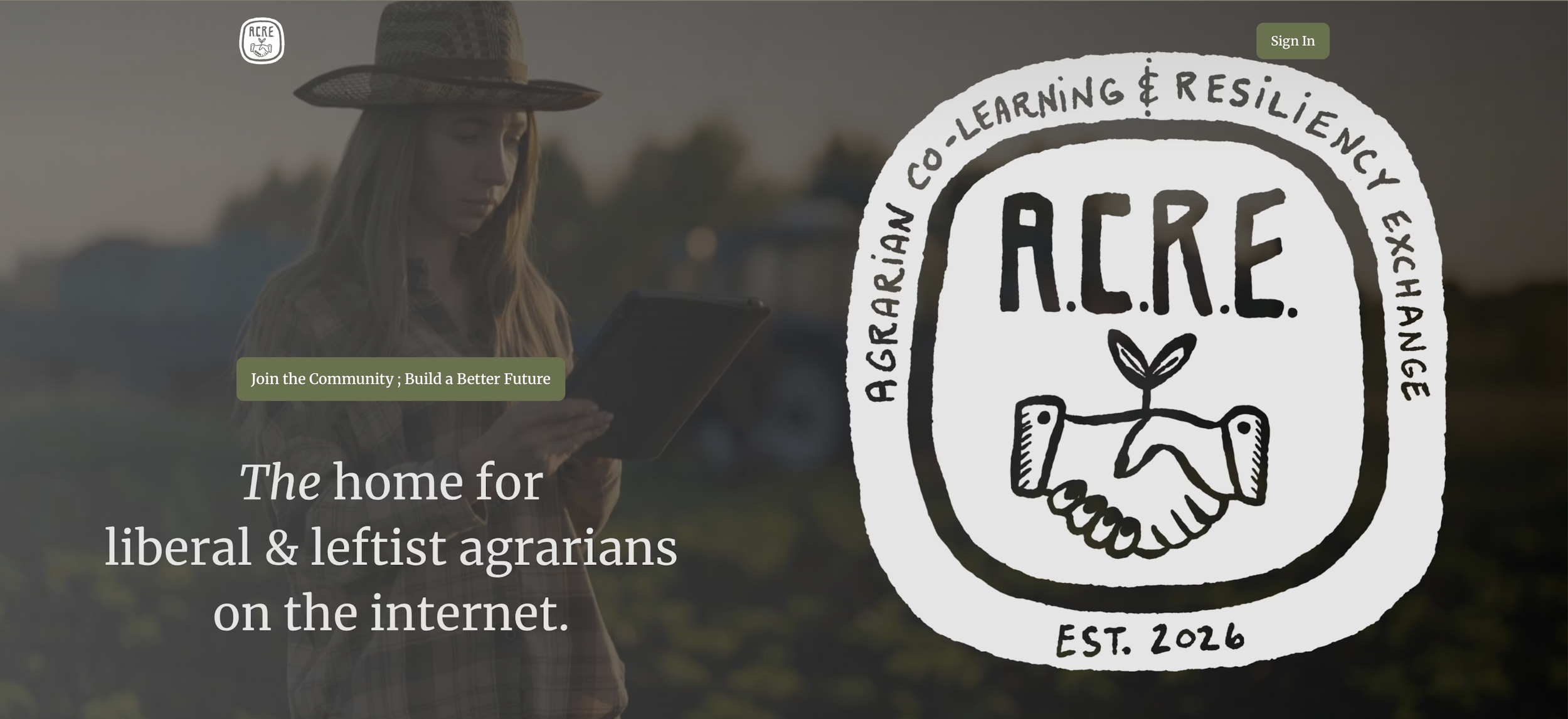
This is not me trying to build a “nice corner of the internet” - that exists elsewhere (albeit in short supply). I am trying to build something that changes what becomes possible in people’s actual lives - including in my own life.
Sometimes that change is small.
Somebody finally asks the question they have been sitting on for two months and gets a straight answer instead of a lecture.
Somebody stops wasting money on the wrong setup because another member has already made that mistake for them and is willing to share about it.
Somebody who has been learning in private realizes they are not late, not behind, not weird, and not the only person trying to do this without swallowing a whole worldview they reject.
Sometimes the change is bigger.
A gardener in an apartment gets serious enough to start producing real food.
A person with a fruit tree and two chickens stops feeling like a dilettante and starts building a durable agrarian practice.
A farmer who has been white-knuckling every season alone finds peers who understand both the work and the emotional nature of the work.
A handful of members in one region start swapping knowledge, splitting wholesale orders, planning IRL workshare days, & making each other’s lives materially easier.
That is the kind of change I care about - the kind of change ACRE wants to catalyze for folks who join. Not “transformation” in the goofy online-marketing sense (eeeew). I mean the kind of change you only notice in hindsight because your days no longer look the same. You know the kind of change I mean. You know more; you panic less. You recover faster. You make fewer expensive mistakes. You have people to ask. You’re not reinventing the wheel in your own head for the tenth time at eleven o’clock at night. You’re looking at the sunset one evening and for some reason you start crying just a little because you realize that the life you have now is so very, very close to the life you once would have killed to have. (Not that I have annnnnyyyy personal stories about any of this, of course…)
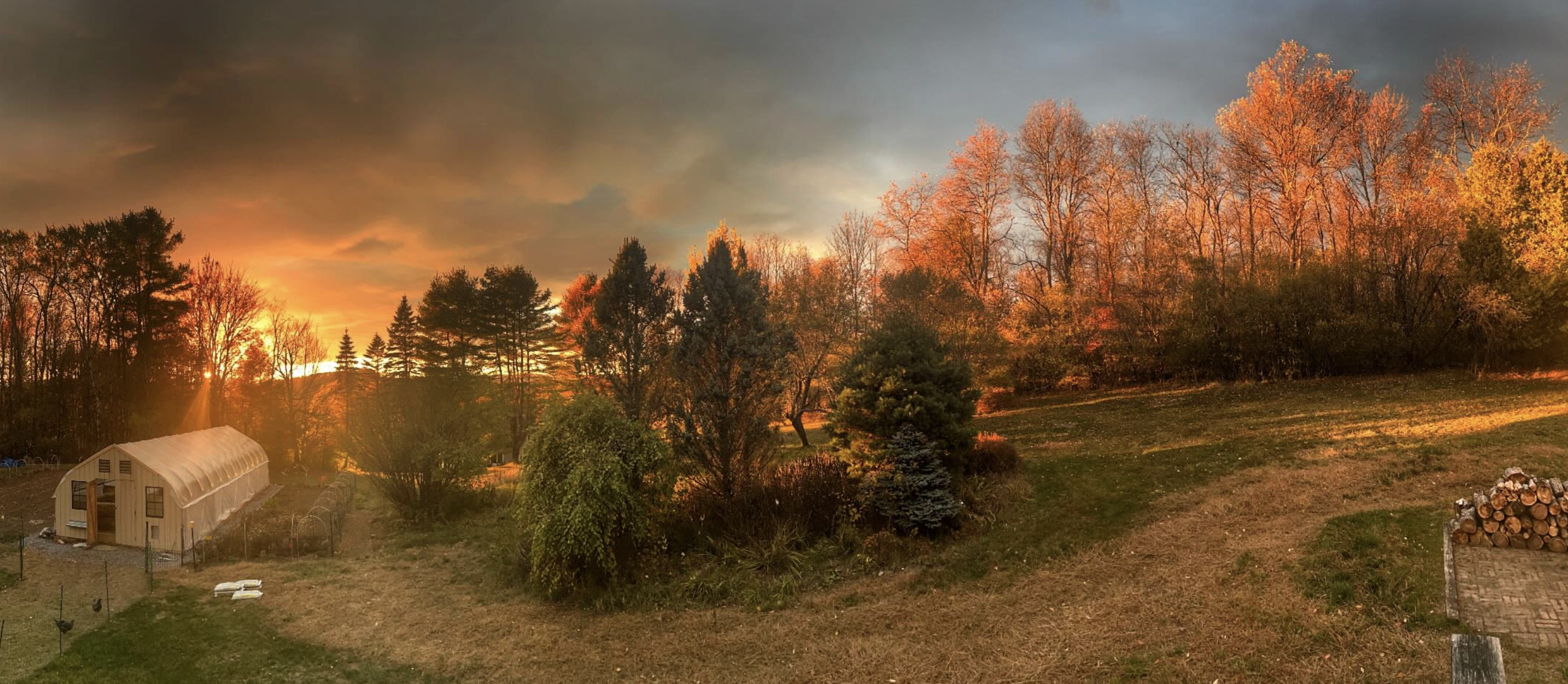
Shut up. I’m not crying - you’re crying!
But transformation like that is hard to come by, especially these days. A lot of smart, committed agrarians (and would-be agrarians) are failing not because they lack information but because information is not the same thing as support, or context, or repetition, or trust. It is hard to grow in public when the available public is either snarky, openly hostile, performative, or trying to sell you an expensive lifemaxxxing hack every six minutes. It is hard to stay with difficult work when you are doing all your learning in isolation and all your self-correction in shame. (Ask me how I know.)
I know this both personally and professionally. I am not just a farmsteader who wants this for selfish reasons, though I absolutely did build ACRE in part for selfish reasons - I need this as much as any of us, y’all. But I’m also a professional learning designer and former college professor. I know that beyond slogans and hype and high tuition and slick marketing and “sage on the stage” educators, there is nearly infinite possibility. I’ve seen what happens when people get the things they actually need in order to grow: good conditions; enough time; a place to return to; peers to co-witness wisdom with; friction in the right places; enough safety to ask for what you need; enough challenge to keep you moving; and enough continuity that people do not have to start from zero every time they show up.
All of this is the spirit and desire and logic behind ACRE.
Inside the community, that means live workshops, 24/7/365 conversation space, roundtable discussions, peer-to-peer learning and troubleshooting, a shared resource library, and ongoing connections that can accumulate into real relationships…instead of evaporating into the algorithm like everything else online.
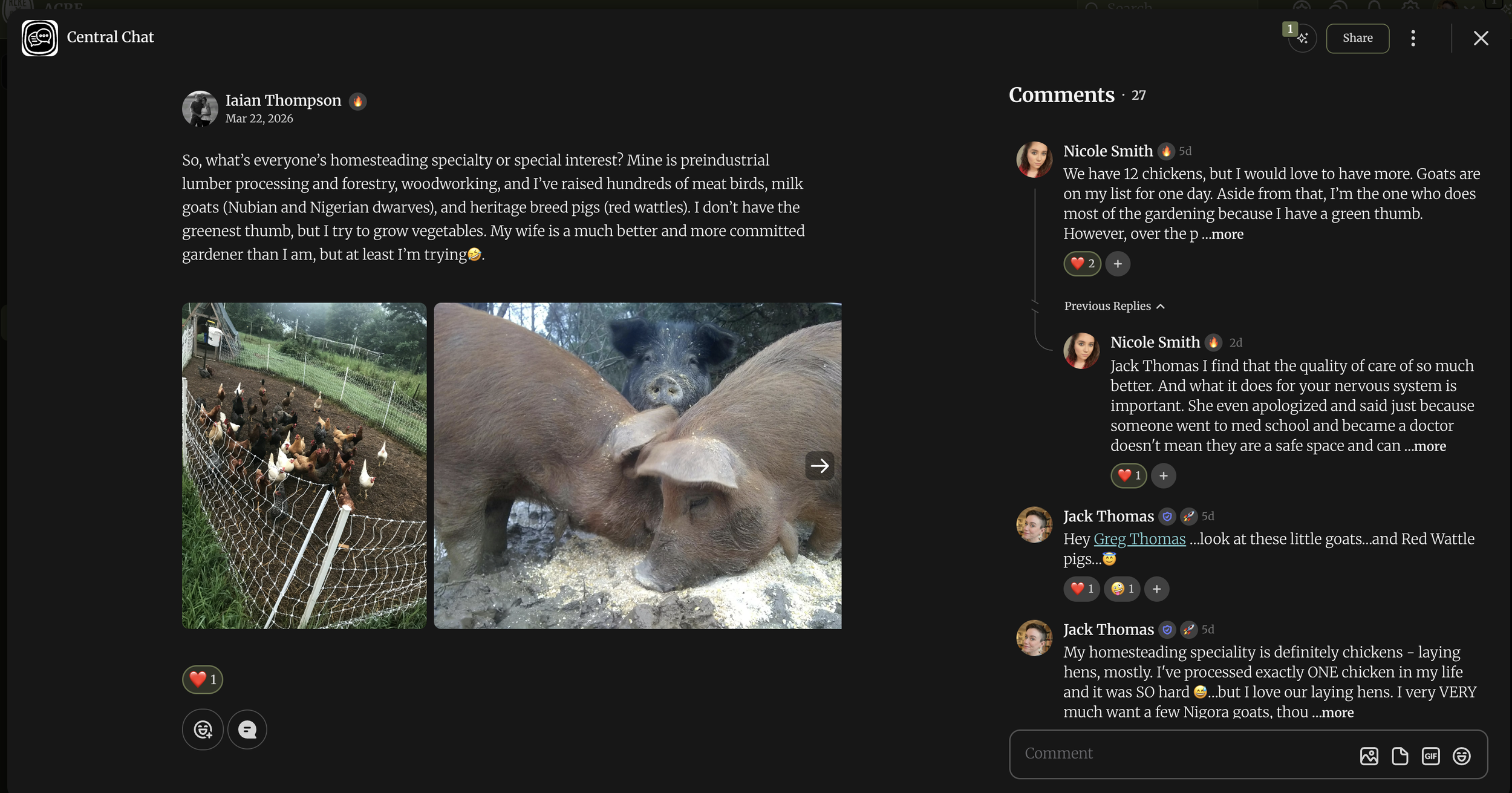
A great member exchange going on in ACRE’s Central Chat.
Some folks will show up because they want help with crop planning, seed starting, preservation, animal husbandry, or business strategy. Some will come because they are sick of trying to grow food, build resilience, and keep hold of their values in spaces full of bots, trolls, performative posts, and reactionary snark. Some will come because they want peers rather than an audience. Some will come because they are done waiting for someone else to reclaim agrarian culture from the alt-right.
Most folks, I suspect, will arrive for several reasons at once. And if something is missing once you get there, then friends…we will make it together.
And this is not only about what any one member gets out of it. I care about that, obviously….but the larger point is communal and cultural. The right has been building an agrarian identity kit for years: aesthetics, aspiration, certainty, hierarchy, a simplified past, a script for gender, a script for family, a script for virtue. They made it visible. They made it sticky. They made it easy to recognize.
What the right built should not be the only thing on offer - we have to build an alternative, and we can only do that strategically, intentionally, and together.
Growing food does not belong to them. Neither does preserving the harvest, caring about soil, raising animals, learning heritage skills, or wanting your household and community to be less fragile. The problem is not that the rest of us do not exist. The problem is that we have been fragmented, under-networked, and easier to isolate than we should be. I hope ACRE can start to solve that.
People - we the people - are hungry for community. We are also hungry for stability, safety, rhythm, prosperity, usefulness, purpose, family, tenderness, competence, connection to nature, and home. We are hungry for lives that feel less synthetic, fractured, tenuous, pointless, and atomized. If the only people speaking directly and cohesively to these very legitimate longings are the people wrapping them in hierarchy, bigotry, propaganda, and beautiful but empty aesthetic then of course some people are going to get pulled in - a lot of people already have.
But that does not mean we surrender those longings to the right.
It means we build better containers for them - together.
That, to me, is part of what ACRE has to be.
I want this to be a place where tenderness does not come with submission baked in. A place where competence is not coded masculine and dependence is not coded feminine. A place where domestic skill land-based life, mutual reliance, and ecological seriousness belong to everybody. A place with enough room for people who are still sorting through what they were taught, what they once believed, what they wanted, and what they are trying to build instead.
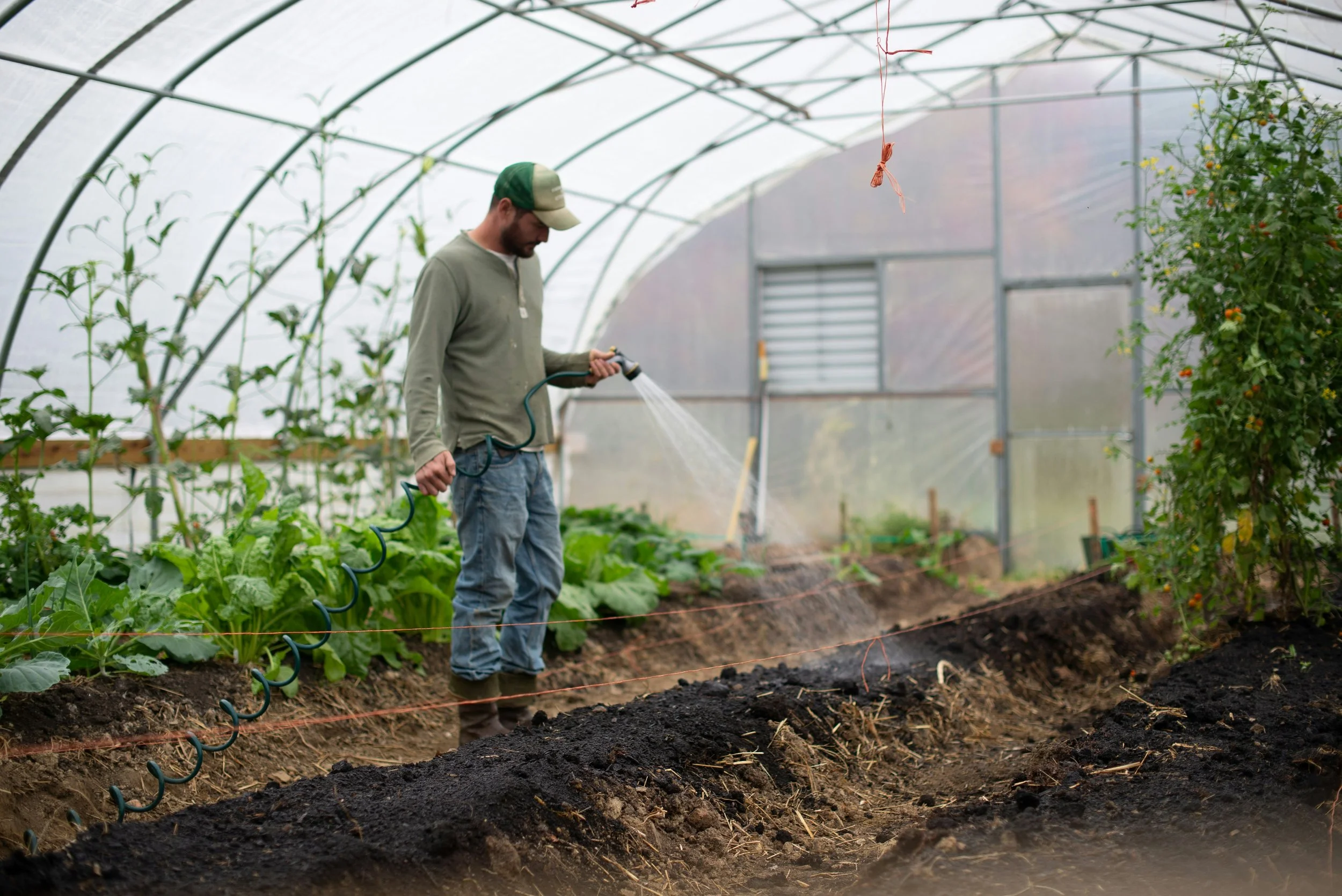
These kinds of things (and the knowledge that powers them) are best built together.
Finally, I want to address a potential elephant in the room: yes, ACRE costs money to join - but not much…and asking for a small contribution to enjoy access to something this valuable does not mean that I’m not a “real leftist”.
Membership is only $5/month or $50/year (and there’s a free trial). You can pay more if you are able and want to support my ability to develop more robust educational resources and bring on expert guest instructors sooner…but you don’t have to.
Some very spicy young internet leftists have reached out to inform me that I’m “not a real leftist” because if I was, I would make ACRE free. I would make it a nonprofit. I would write grants to get money to offer free seats. There’s a lot to unpack there but I don’t want to validate this kind of sophomoric thinking overly much, so I’ll just say this: as a leftist, I advocate for universal access to essential services including (but not limited to) healthcare, education, and public transportation…and for that access to be funded through progressive taxation that prohibits the existence of a billionaire class. And, while I think ACRE has the potential to be a real source of community support and cultural change - and already is an alternative to Meta-owned platforms where our attention and data are how we pay for access - it is not an essential service.
Also, I am not in a position to perform labor for free. I’m a self-employed learning designer that often accepts farm products in partial barter because times are hard. I’m also a scrappy farmsteader, and have financially clawed my way into that role. I’m a person who has already spent hundreds of unpaid hours building an internet community that I hope can change the agrarian world for the better. The infrastructure to keep that community running costs money. Moderation, design, teaching, hosting, organizing, and tending a space like this are labor. My continued labor needs to earn money - if it doesn’t, I cannot continue to exist in a capitalist society any more than these fiery young internet leftists can. We would lose our farm - our home. I’m not an influencer trying to appear like I have my shit 100% together and am happily immune to the downward spiral of America’s economy. I’m not going to insult anyone’s intelligence by pretending ACRE is immune to that, either. I want this community to be sturdy. I want it to be honest. Most of all, I want it to last long enough to actually matter.
So…mini-manifesto rant over.
What I’m saying here is, if you’ve been wishing there were a place where actionable agrarian tools + learning, a safe political home, and real peer-to-peer support could coexist for liberal and leftist homesteaders, farmers, and gardeners, then wish granted, friend! - I built one.
If you’re tired of waiting for somebody else to build the agrarian culture you want to belong to, hey, great news - I got it started for us.
(Now we have to keep going together.)
ACRE exists because agrarians at every scale need more than inspiration - we need each other.
I hope you’ll join me and help write the growing history of liberal & leftist agrarian culture…and maybe have your best year yet in the process.
If you’re interested, you can learn more here, and join ACRE today.
See you there, friends - and thank you.