The realistic strategy isn’t panic-buying a year of freeze-dried rations. It’s a one-month buffer, a long-haul food system...and neighbors who know each other’s names & needs.
Disclaimer: I’m not a licensed professional in any of the fields covered in this article…I just have training (professional + school of hard knocks) and a few decades of life experience in these arenas. Please take the following input as a jumping-off point for conducting your own research and preparations. By continuing to read this article, you understand I’m not accountable for your full or partial implementation (or lack thereof) of these concepts.
Sorry it even has to be said. 🤷
For most of my life, people have known me as something of a “doomsday prepper.” I prefer Societal Collapse Awareness & Readiness Instructor (or SCARI, if you’re into on-the-nose acronyms)...but whatever.
Basically I’m no Navy SEAL, I don’t teach these topics professionally anymore, and I’m even a little out of practice on some of these things myself…but if the zombie (or MAGA) apocalypse comes, you definitely want me on your team.

Me, circa 2012, trying out a new-to-me firearm during a training exercise. It might look like an assault rifle, but it’s really just a Ruger 10-22 with a fancy tactical package.
I recently took a trip to meet my husband’s best old friends in New Orleans. I was offline for fewer than five days. A visit to the Lower Ninth Ward already had me thinking about disaster preparedness, so when I came back online and saw the news - Trump (and Netanyahu) started a wanton, senseless war with Iran - my brain was already in resiliency-prep mode. Coming back online also showed me an inbox full of a familiar kind of message: friends and even a few strangers asking how to prepare for a war where everyday Americans - not just American soldiers - actually feel the impact of war, and are wondering if it’s time to “bug out.” (Rarely a good idea, BTW.)
When protracted disaster is on the horizon, the temptation - especially in a country trained to treat every crisis as a shopping opportunity - is to sprint to Costco and purchase your way to peace and preparedness. That urge is understandable. It’s coded into us as Americans. It is also incomplete.
A war like the one being heartlessly waged on Iran doesn’t need to put “raiders” (á la Negan of the Walking Dead) in your driveway to upend (or end) your life . More often, it hits you in the boring, brutal places: energy volatility; shipping disruptions; price spikes; supply delays; “sorry, backordered”; and a general tightening of daily life until nerves and social fabric start to fray. Reuters has been reporting on the risks to economic resilience and domestic disruption due to the situation in the Strait of Hormuz, a key global oil chokepoint. Frankly, if we think about the potential domino effect this could have over the next few months, they’re not telling us the half of it.
So here’s the real talk for my fellow liberals and leftists who are tired of panic, tired of right-wing doomsday hoarder culture, and tired of trying to survive on vibes: prepping needs two forms. Both are absolutely necessary - no exceptions.
A short-term buffer that carries you through the shock period when shelves are bare, prices jump, and systems lag.
A long-haul resilience system rooted in food, skills, and relationships that don’t expire, run out, or make you a target.
Pop-culture prepping (a narrative largely owned by the right-wing tradwife types, UGH) is obsessed with stuff…but stuff runs out. Stuff can be stolen. Stuff can become a weird substitute for confronting reality. And frankly, stuff can make you a target, especially if you swing your dick about it like so many MAGA bros love to do. But systems are different. Skills are different. Neighbors are different.
Raiders can steal supplies. They can’t steal a system that they don’t know how to use.
Stick with me through this article, and we’re going to dive into how to start building those systems.
A quick reality check before we go any further
Official preparedness guidance is not “everyone needs six months of rations.” That’s not practical for most of us anyway.
Ready.gov says you need “at least a several-day supply” in a basic kit.
The American Red Cross recommends a two-week supply of food and water for home, and a 7-day supply of medications as part of preparedness.
The CDC guidance emphasizes working with your doctor or pharmacist on an emergency medication supply and keeping a detailed medication list.
Now, for the record, I very much believe in science and generally trust experts…but I’m recommending a larger one-month buffer if at all possible for you (and a little more never hurts if you can comfortably financially swing it and have the space to store it).
So why am I going to recommend a one-month buffer when the expert orgs suggest otherwise?
Because official baselines are designed to be broadly attainable, not maximally stabilizing. They may also be so short because these prep scenarios are typically based on an acute emergency (flood, hurricane, etc.) - not a protracted one.
Please note, though: not being able to prep for a one-month buffer is NOT a moral failing (IMHO, it’s a social failing of capitalism). It is, however, a goalpost worth moving toward if you can because a month buys you time, time buys you options, and options are what keep people from making desperate choices. In a supply disruption, a month is often the difference between riding out chaos and unwillingly joining it.
If you’re strapped, start with 3 days. Then 2 weeks. Then 30 days.This isn’t a purity contest. It’s a practice. And if you keep on top of your practice and start to view being prepared as a way of life (not an occasional anxiety-driven shopping and research spree), you’ll be better prepped for actual, long-term resilience than that guy who keeps 400 servings of shelf-stable beef stroganoff and some iodine tablets in his basement.
The one-month buffer (what it is and what it isn’t)
A one-month buffer is not a bunker fantasy. It’s not a year of freeze-dried meal buckets that taste like packing peanuts. It’s not hoarding. It’s not “I don’t need anyone.” (We all need someone. We all need each other.)
Let’s Talk About…The Food
A one-month buffer is a boring, practical cushion that says: “My household can keep eating if the store is chaotic or even empty for a few weeks.” It’s stocking up on what you will actually eat, and learning how to cook and eat what you stock up.
IMHO, the best “prepper pantry” often looks a lot like a normal pantry - just deeper.
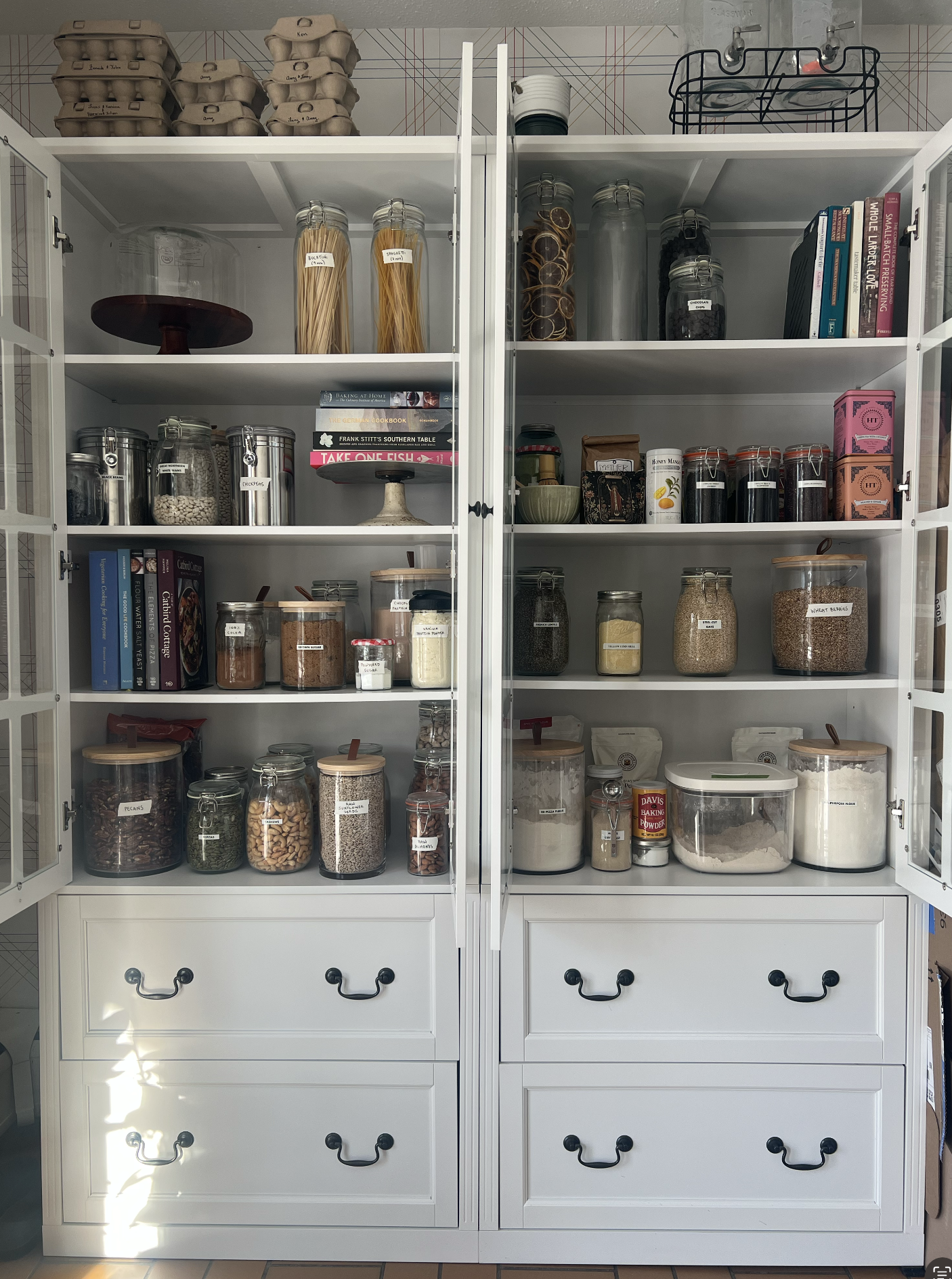
This is our “everyday” dry goods pantry…where we rotate in smaller amounts of the deeper stores of raw ingredients we keep in our absolutely hideous, dungeon-y utility room. Canned goods, store-bought snacks, frozen stuff, and liquids are in our other pantry + our fridge/freezer.
A solid month buffer can be built around staples you probably already know how to cook. Here’s what that looks like for us:
Rice, oats, wheat berries, pasta, & flour
Beans and lentils (canned is ok if you don’t cook dried legumes well yet)
Canned/jarred faves like tomatoes, tuna, chicken, peanut butter, corn, salsa, etc.
Cooking oil, salt, sugar, and spices + baking ingredients you genuinely use
Shelf-stable oat milk + whole milk powder
Frozen veg, fruit, and meat if you have freezer space
“Morale food” that keeps you sane (coffee, tea, chocolate, whiskey, whatever your household needs to not implode…I cannot stress the importance of this enough)
The rule is simple: rotate. Eat through it. Replace it.
If you stock it and let it sit, it’s not just the food that will eventually go bad - so will your ability to be the kind of person who is prepared to actually use what you have. Become a person whose pantry is always quietly prepared so you can be a cool, calm survivor - and beloved crisis chef - when SHTF.
Let’s Talk About…The Water
Bottom line: store what you reasonably can - and more than you think you’ll need need - then have a plan to replenish it less than halfway through your stash.
Last I checked, the Red Cross recommends one gallon per person per day, and suggests two weeks of water for home if possible. Most people cannot store months of water unless they have serious space and a serious plan. So, store what you can and then make a plan so you can access more. Have a nearby body of fresh water? Awesome. Rainwater collection barrels? Sweet. Municipal pool? It’ll do if it has to. Toilet tanks? Sure, if sh!t has really hit the fan. (But never the toilet bowl…please.)
If your water source might not be clean (like some of the above), then having a filtration mechanism (like something from LifeStraw) is a great idea, and plan to boil the water for at least 3 minutes after filtration to kill any remaining pathogens, etc.
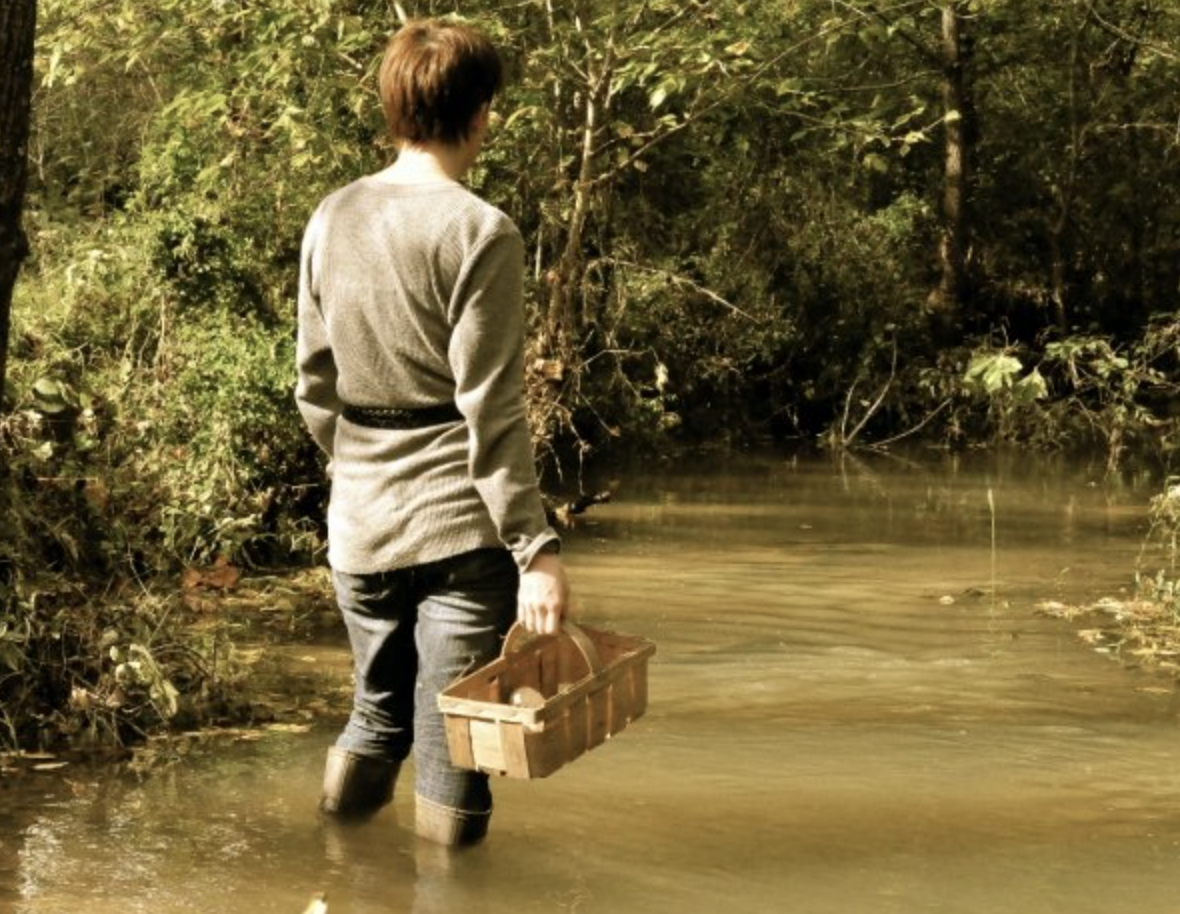
I’ve found myself in need of water from questionable sources before. The best thing you can do is to not let yourself get into this pinch by keeping potable water on hand. The second best thing you can do is have a good filtration system + a way to boil the filtered water. Some folks say it’s overkill; I say it’s better than being killed.
Have a drilled well, and feeling lucky about it? Us too…but don’t get too comfortable. We’re lucky to have a strong well with 24/7/365 artesian overflow at the edge of our property, but that doesn’t get water to the house if the well pump isn’t working. The pump went on the fritz for two days last month and having eight gallons of water in jugs so we could drink, wash, and flush the toilet felt like solid gold. So, even if you have a deep well and backup power for your pump, having water on hand is still important.
A realistic water plan should include:
Some stored water (as much as you can manage safely and sanely)
A way to carry water if you need to haul it (gallon jugs, food-safe buckets, etc.)
A filtration + boil plan for water from questionable sources
A “now, not later” rule: never wait until you’re desperate to figure out where your water comes from.
Let’s Talk About…The Meds + Agrarian First Aid
The CDC’s prescriptions preparedness guidance is clear: talk to your doctor or pharmacist about emergency supply options, keep a current list, and plan for refrigeration needs if you have meds that require it. The CDC’s preparedness materials also reference keeping a 7–10 day supply as a basic step.
Some people can get a 30-day refill buffer…some can’t. Insurance rules and controlled substances are real constraints. (This is especially true for us ADHD folks who use stimulant-based meds.) The goal is not “have enough Adderall to outrun the apocalypse.” The goal is “don’t get caught with nothing.” And if your doctor is open to listening to your prepping plan and writing you prescriptions for some emergency basics to keep on hand (antibiotics, topical steroids, etc.), even better…as long as you actually know how and when to use them, because they’re dangerous if you don’t. Let me repeat this again: I was able to acquire these things through a physician friend who felt comfortable writing me those prescriptions because they know I understand how and when to safely use these medicines. If you don’t, then they can be more dangerous than helpful…and no, ChatGPT is not a reliable source of medical info.
Now, regarding “agrarian first aid”, it’s a real need because growing and raising food is physical work and involves real physical risk.

My amazing, adorkable husband sustained a deep knife wound to his thumb last October while we were miles from medical aid. But with basic wilderness medical training and a robust first aid kit, I was able to disinfect the wound, staunch the bleeding, seal the wound from further contamination, and immobilize the joint that got deeply cut into…all in time to get a beer before sundown.
A one-month buffer should include basic first-aid and “I was outside all day like an idiot” supplies: bandages, disinfectant, tweezers, antihistamines, sun protection, sunburn relief, electrolyte packets, surgical scissors, sterile gloves, pain reliever/fever reducer, eye wash, and whatever else your household already uses for minor injuries. If possible, I also like to beef up an agrarian first-aid kit with a SAM Splint, a SAM tourniquet, WoundSeal powder, topical anaesthetic, a suture kit, and a headlamp. When you’re working with animals, power tools, knives/axes, or large equipment, the likelihood that you’ll need to brace a broken bone, stop bleeding, or stitch something up increases exponentially. HOWEVER, if you don’t have training, PLEASE stick to basic first aid and consider taking a Stop the Bleed and/or Wilderness First Aid and/or Wilderness First Responder course before you start playing field medic. It’s also important to note that taking these courses then letting the skills go fallow isn’t a great strategy. I used to be a certified Wilderness First Responder but I let that lapse, and now I feel like I’d be hard-pressed to keep my cool while dealing with a real emergency like an open fracture. Practice is essential. We have to make it a way of life.
Now, the Real Prep: Building a Food System - and a Community System - That Renews Itself
Everything above this heading buys you time.
Time is the bridge to the only thing that works long-term: renewable systems.
That means:
Growing and raising food while maintaining soil health
Learning to cook staples
Safely preserving some of what you grow
Saving seeds
Trading skills, knowledge, and labor within a network of real people
Knowing key details about your neighbors (allergies, skills, etc.) and making sure they know you back
The fastest way to describe the difference is this:
Material prepping is a stockpile. Systems prepping is a lifestyle.
And I’m going to say something that might sound rude, but please believe me when I say it’s actually compassionate: A tomato plant is not a food security plan (but it IS an introduction to one).
Why am I calling out tomatoes? Because we all love them so damn much.
Tomatoes are great. They contain nutrients we definitely need. They make us happy. They’re an incredible addition to staple foods…but they are not very meaningful in the “survival calories” department. So, they do make my list of things to grow in a crisis…but they’re not at the TOP of the list.
IMHO, a resilient long-haul renewable food system focuses on:
Storage crops (potatoes, winter squash, onions, carrots);
Staples (beans, lentils, grains, and corn);
Greens, brassicas, and fruits for nutrition (yes, including tomatoes);
Herbs for flavor and medicine-adjacent support (not a replacement for medicine);
Eggs for added protein support, if your property can support hens without damaging soil health; and
Meat + dairy, if you can raise meat and/or dairy animals sustainably on your acreage…
…and then sprinkle in joyous additions according to your taste.
I hope this doesn’t make you think I’m advocating against your tomatoes. I’m not. Hell, we’re growing at least three varieties this year, along with cutting flowers, blueberries, herbs, Asian greens, alliums, ornamental grasses, and a whole host of completely unnecessary-for-survival things. Why? Because at the end of the day, a little whimsy - like growing tea plants in Vermont - is absolutely necessary for long-term surviving & thriving.
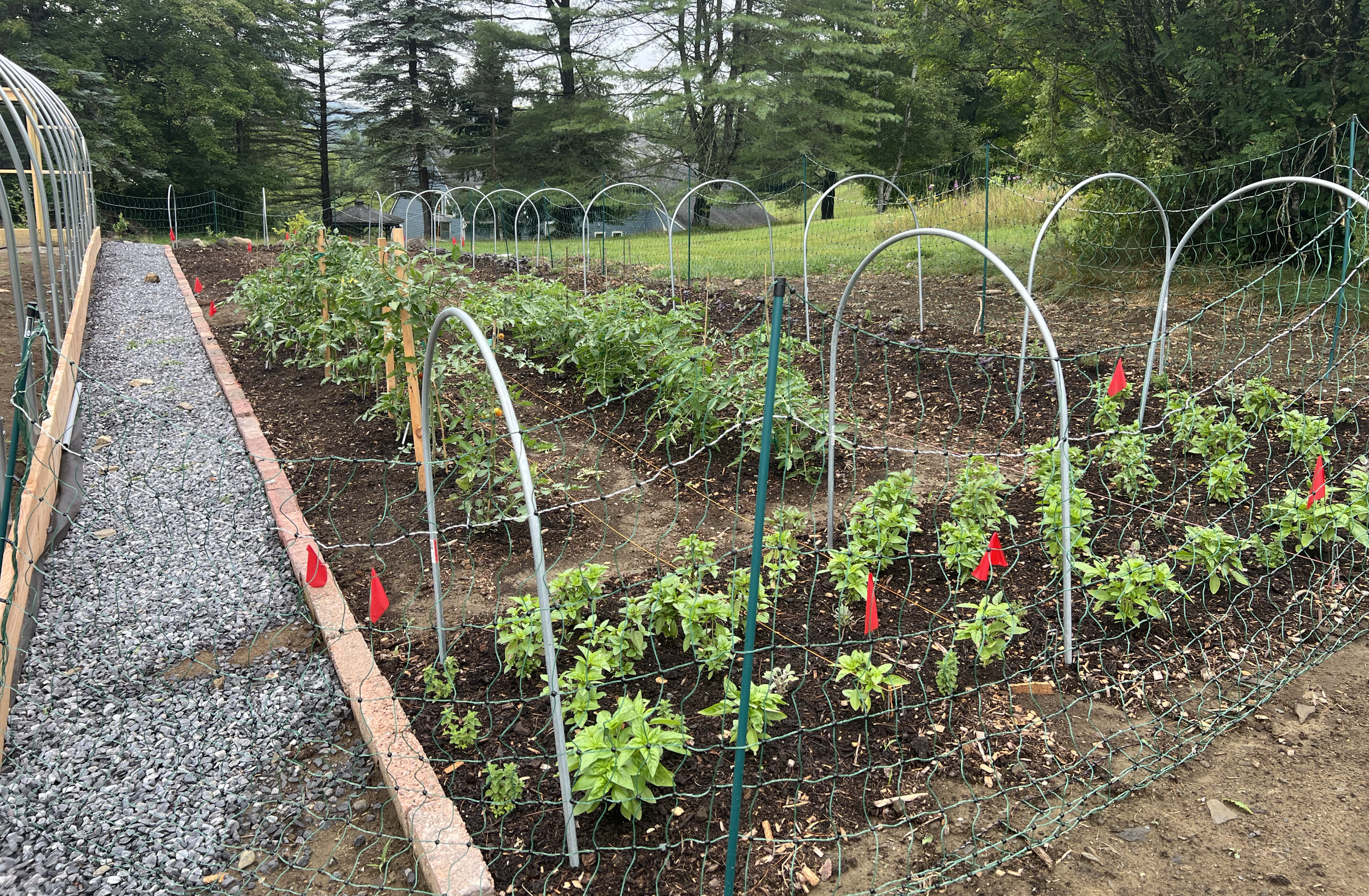
Girl, I’m not judging you for your tomatoes…there is LITERALLY NOTHING but tomatoes and herbs in this photo! But that was last year. This year is different. And even last year, I really should have done more storage crops and saved more seeds. We live and learn (hopefully).
A Look Back
During World War II, Americans grew food at home at a scale that is hard to imagine now. USDA materials note that there were more than 20 million victory gardens in 1943, producing billions of pounds of food, and that in 1944 those gardens provided around 40% of the U.S. vegetable supply.
Two things matter about that, and neither of those things is nostalgia or tradwife aesthetic.
A huge portion of those gardens were urban and suburban, not rural.
Also, victory gardens weren’t just about food. They were about morale, agency, and a society practicing competence together. (Source)A “long disaster” - like a protracted war - demands something similar of us all…whether we know it yet or not. The best time to start learning these skills and building aid networks was a decade ago. The second best time is NOW.
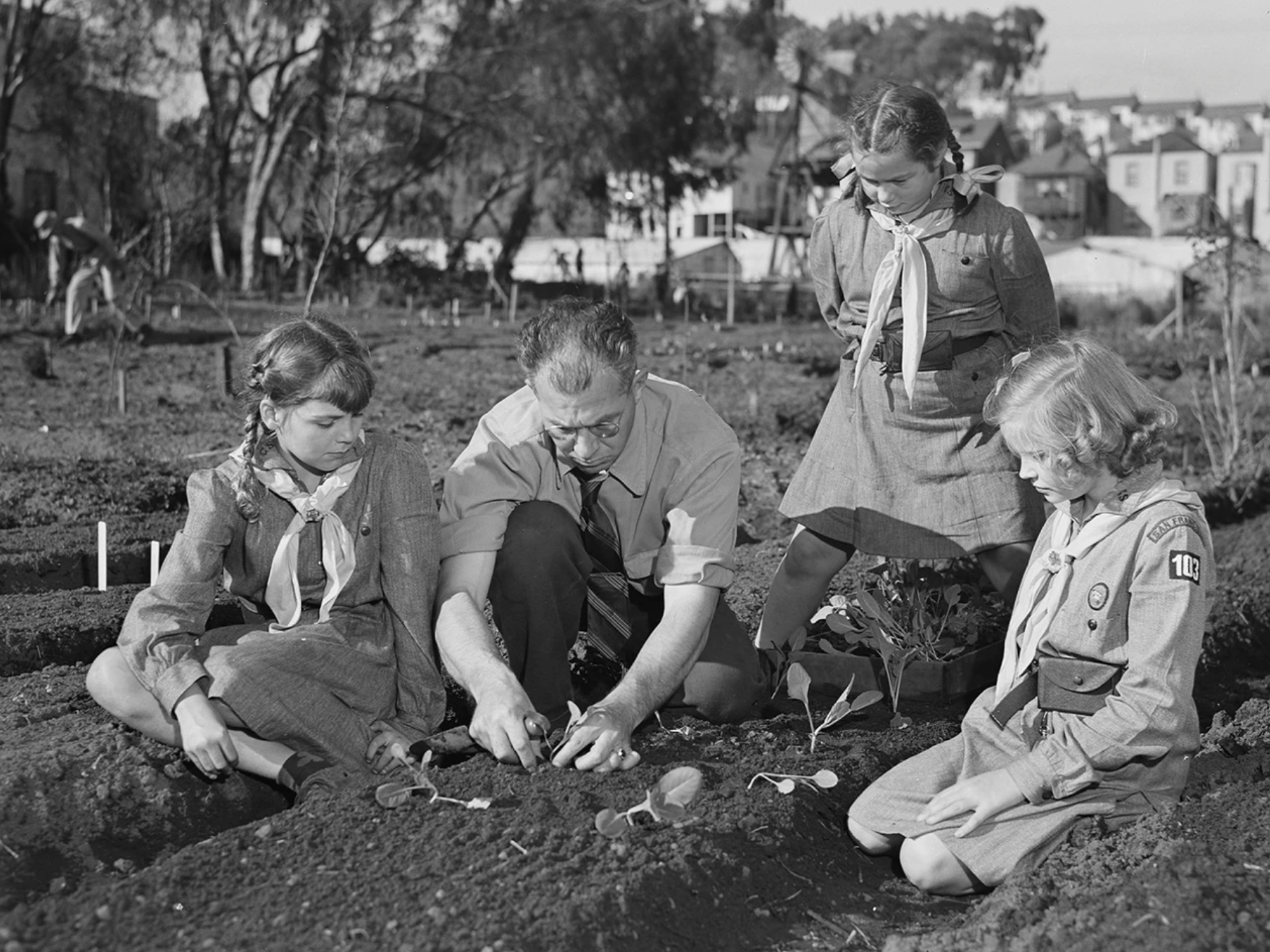
“Guiding hand behind many West coast Victory Gardens, Prof. Harry Nelson still finds time to give his 10-year-old daughter and her Girl Scout friends some pointers in transplanting vegetables.” Photo by Ann Rosener, Office of War Information, March 1943. Credit: Collection of the Library of Congress (https://lccn.loc.gov/2017696713).
Two Readers, Two Paths, One Future…and What To Do Next
I wanted this article to speak to two groups of folks:
urban/suburban readers with limited land, and
farmers/homesteaders who feel the weight of being the “resource person” in their community.
I’ve been in the former group; now I’m in the latter. Both groups matter for our long-term survival and thriving, and the bridge between us is where resilience lives. So, here’s how we start to build that bridge.
If you live in an apartment or a suburb
The point is not to feel guilty or anxious about not owning acreage; most folks don’t. The point is to become useful to yourself and your community, and connected to as many safe people as possible.
A food resilience path that actually works for you might look like this:
Step 1: Build a one-month buffer…slowly…and actually use it.
Start with what you already eat. Add a little extra to the pantry each week. Make it boring. Make it normal. Make it part of who you are. And don’t forget to keep eating, keep cooking, and keep rotating. I better not see any dusty jars of lentils in there.
Step 2: Grow something real.
If you have a balcony: grow greens, herbs, a compact pepper, maybe even a potato bag.
If you have a patio: grow potatoes in bags, bush beans in containers, greens in tubs.
If you have a small yard: grow veg, greens, herbs, potatoes, and more in raised beds.
If you have no space or want to really add to your home footprint: join a community garden, or offer labor to someone who has land. (Please note: it takes a lot of work for a farmer to train you to be useful around the farm, and having you there can constitute a liability. Please expect to sign a waiver, and please don’t get trained and then just bounce.)
The goal here isn’t Instagram produce.
The goal is competence, connection, and calories.
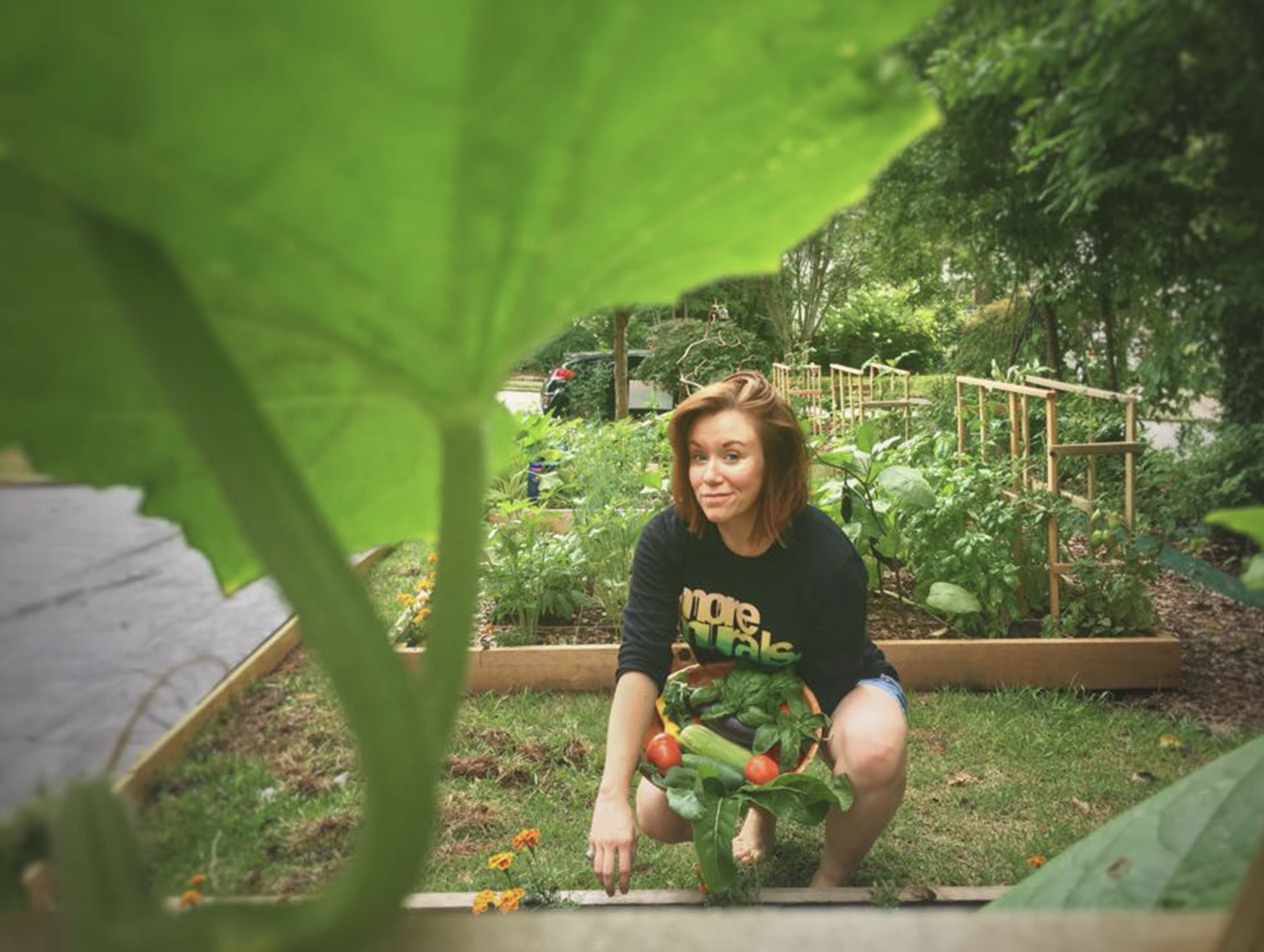
Me in my front yard garden in College Park (Atlanta) circa 2016 - my first solo food garden. Small but mighty! I learned SO much that year.
Step 3: Learn three pantry meals by heart.
I’m not talkin’ recipes you screenshot and never cook. We all have plenty of those already. These should be meals you can make when you’re tired, stressed, and DGAF.
Examples:
Lentil soup with canned tomatoes and spices
Rice + beans + whatever greens you can get
Oats with shelf-stable add-ins
Tamago kake gohan with greens (my personal fave…this is a Japanese comfort food dish of egg and rice with soy sauce and it basically cooks itself. I’ll share my recipe soon!)
Step 4: Build a small mutual aid network centered on food and co-care.
This does not require a nonprofit. It does, however, require a little nerve and a lot of patience.
Here’s a starter script for building your network (text message, low cringe):
“Hey, weird question. With everything going on, I’m trying to get more serious about food resilience and local emergency planning. Would you be up for a casual ‘neighbors prepping plan’ chat sometime? Nothing intense…just practical stuff.”
Then ask four simple questions:
Who grows food already?
Who has even a little land to spare for expanding food production?
Who cooks well from staples?
Who has useful skills (first aid, repair, childcare, transport)?
This is your seed. Grow it.
If you farm or homestead
This is where I get blunt, because I have watched too many capable agrarians grind themselves into dust out of guilt when they’re trying to feed folks in need.
So, please listen and repeat after me:
Community resilience is not one burned-out farmer feeding twenty households for free until the farmer collapses.
If you’re the person with land, skills, equipment, or animals, you can help your community without becoming a martyr. In fact, martyring yourself actually hurts your community because you can’t serve from an empty vessel. You can’t train the next generation or empower your neighbors to succeed if you’re toast.
IMHO, a sustainable model looks like this:
Teach in public, sell in private.
Offer free “basics” workshops once in a while, then offer deeper training as paid classes. This honors your time while proactively building a competent labor force who can spring to action if SHTF.
And if someone gives you flack because “if you were a ‘real’ leftist or ‘really’ believed in mutual aid, you’d offer all of this for free”…please show them the door and send them my way so I can set them straight for you. My pleasure, truly.Build labor-for-learning exchanges.
Town folks often want to help but don’t know how to be useful. Don’t let them cosplay farmer - you don’t have time for that and this isn’t a “do it for Instagram” situation. This isn’t for optics - it’s forreal. Give them a real role and real training…but only in exchange for real work that they really follow through on for a real agreed-upon duration of time. You know that giving them two weeks of intermittent training isn’t worth it if they’re only able to help for the month of June. Make sure they know it, too. This is about long-haul relationships. And if you can pay them, great. I believe in paying people when we can because otherwise, only the privileged will be able to afford the time to learn these skills and we all know that skills don’t necessarily pay the bills…but money does.Create structured membership models.
CSA-style arrangements, neighborhood buying clubs, co-op purchasing, neighborhood farms…there are a bevy of unique models that can support your operation, and that you can be part of as a buyer yourself for cost savings.
For models where money flows into your farm, when people pay in advance (or at least pledge in advance), you can plan reliably. This can start small, and even stay small and create resiliency for you and food security for your neighborhood.
For example: here at Foggy Ridge Farmstead, we’re slowly scaling ourselves to meet the egg, herb, greens, and dairy needs of only the households within walking distance of our farmstead - only about 20 families. When we’re eventually selling eggs to every household in our neighborhood, assuming half of them want a dozen each week and the other half want a 1/2 dozen, we’ll be bringing in $4860/year in revenue from just our egg sales, all while ensuring our neighbors never have to pay $9/dozen for eggs…if they can get them at all.Recruit non-farm skills.
Ask for bookkeeping, website help, childcare swaps, delivery assistance, farm-sitting, morning milking, grant writing. Farmers don’t need twenty more opinions about how to steward our land. We need support. This can also be a great way to make the value of a labor-for-learning exchange more accessible to working adults with bills to pay. If they can’t come work on the farm during the day due to a W-2 job or childcare responsibilities but you can upskill them a few evenings or weekend days each week, they may be able to offer you childcare during the day, or write a grant to help you get that money for a new high tunnel.Set boundaries that protect your peace and your family.
“Yes, here’s how to join our work & learn crew,” beats “Sure, I’ll give you some eggs.”
The first builds a system that serves everyone. The second builds resentment that eventually fractures aid networks for the whole community. There’s nothing wrong with one-way charity to someone you barely know…but it is not mutual aid.
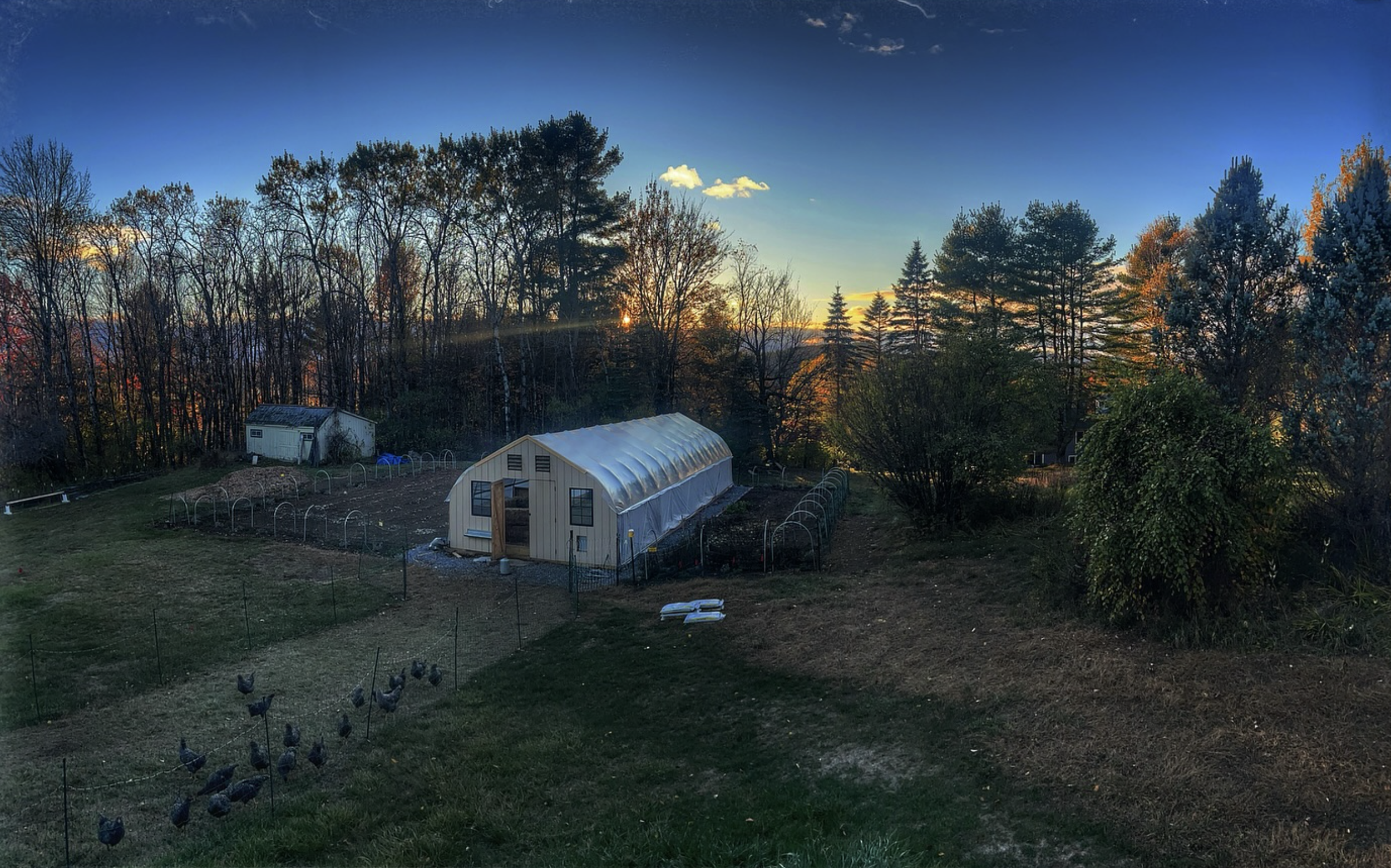
Our 56x70 growing plot with 16x48 Rimol Bobcat high tunnel and flock of heritage laying hens, basking in a late autumn sunset. We’ll likely expand our veg/storage crop growing area beyond this at some point, but only if we can do it without burning ourselves out. Otherwise…what’s the point?
This is where your leftist prepper ethic becomes visible and essential to long-term personal and community survival: this is not dragon-guarding-gold isolation, and not charity-as-self-erasure. Neither of those work for very long. The only thing that does work over the long haul is structured interdependence.
Things that feel like prepping but aren’t
Here’s a short list, because it helps to check yourself before you wreck yourself.
Please don’t do these things:
Buying gadgets and gear before buying food you actually eat
Stockpiling things you don’t know how to use (especially advanced first aid stuff - bad things can happen. Please promise me you won’t do that.)
Pretending “I’ll just hunt or fish” is a plan (If I handed you a knife, could you process that deer or clean a fish right now? No? Then don’t play yourself, friend. Learn how.)
Starting a garden with no plan for watering, IPM (integrated pest management), or cooking/preserving what you grow
Treating preparedness like a one-time shopping trip instead of a habit (looking at you, my fellow Costco lovers)
Convincing yourself that enough internet research or accumulation of stuff/books will save you later even if you don’t do hands-on training with other people or on your own now (looking at you, my fellow ADHD/autistic friends…love youuuu…)
Preparedness is not a performance. It’s not an identity. It’s a practice.
When done right, it will reduce anxiety - not manufacture it.
How, Then, Shall We Live?
A month from now, this needless and illegal war on Iran will likely have escalated, settled into a long grind, and be expanding across the Middle East (and possibly further, maybe even onto home soil…who knows?).
No matter what happens, the “long disaster” model is still the sane one, because global instability is not a special event anymore. It is becoming a new form of weather. We should all keep a regular eye on the forecast and know that a 15% chance of rain can precede a 100-year flood, much to everyone’s horror and no one’s surprise.
So here’s what to do, in my humble opinion, in plain language.
If you are an apartment/suburban dweller:
Build a one-month pantry buffer over the next 4–12 weeks (small weekly additions with as much as you can comfortably afford up front…but no heroics, no panic buying)
Store as much water as you can realistically manage, and know where you’d get more (and how to make it drinkable if it might not be)
Make a medication plan with your pharmacist, and keep a written medication list
Grow one meaningful edible thing this season, even if it’s in a container
Text three neighbors and start a food-and-first-aid resilience conversation
Find a local farmer, community garden, or place where you can hone your skills and expand your growing footprint
Shameless plug: join an agrarian co-learning + mutual aid community like A.C.R.E. (Agrarian Co-Learning & Resiliency Exchange) for collaborative learning in a friendly environment, moral support, no right-wing BS, + an online community that helps you build offline community in your area.
If you are a farmer/homesteader:
Expand production of one calorically-dense, versatile-cooking storage crop
Decide what you can offer without burning out (discounted surplus, teaching, seedlings, a CSA, organizing a bulk foods buying club or food preservation club)
Ask for the support you need (labor, grant help, deliveries, childcare, admin help)
Host one practical “Food Resilience 101” gathering to hear current community concerns and gather info on skills & resources your neighbors have, then create a structure for people to join ongoing work
Protect your personal + household emotional, mental, physical, and farm infrastructure capacity (because collapse does not get less demanding over time)
Shameless plug again: join an agrarian co-learning + mutual aid community like A.C.R.E. (Agrarian Co-Learning & Resiliency Exchange) so you can identify folks in your area who might want to do labor-for-learning exchanges, and also because I’m 100% cool with farmers selling their wares and promoting their educational content in the dedicated space I’m building for that.
This is the left’s version - our version - of preparedness: not bunker-brained, not consumerism-as-solution, not macho, not isolationist.
It’s competence, community, humility, food, and reciprocity.
The MAGA folks bragging about having 10,000 bullets while sucking air from a Medicare-provided oxygen tank like to think they’ll charge in and take the goods of gentler folks by force. This is largely delusions of grandeur, of course…but just in case, please take my advice to build systems that are even more robust than your stockpiles. If you do, those folks will either wither on the vine or come over to the good side while the rest of us have annual autumn equinox feasts with our neighbors.
Bottom line: the future belongs to people who can - and are willing to - feed themselves and each other in ecological partnership with the earth.
One last thing: guns.
I’d be remiss if I didn’t mention the one thing that inevitably, eventually comes up in all preparedness conversations: guns.
The Walking Dead (and other Hollywood fodder before and since) made guns a very central part of post-apocalyptic survival scenarios. I’m not saying that’s not a likely reality, or that guns are inherently bad - I’m just saying that the spotlit pedestal right-wing preppers have put guns on is irresponsible because they don’t equally elevate the necessity of consistent weapons training and familiarity with your specific firearms.
Some people include firearms in their household safety plan. If that’s you, super cool; I’m a 2A leftist, so I’m with you on this. I grew up around guns, took years and years of marksmanship training, and for a while handled weapons on an almost daily basis…but I know how rare that is especially for those of us on the left.
I cannot state this loudly enough: if you want to add firearms to your sensible prepper plans then PLEASE do it lawfully; train with reputable instructors; understand your state laws; store firearms and ammo securely; and regularly practice loading, unloading, unjamming, firing, and cleaning your weapon.
A gun is not a survival system. It is not a mental health plan. It is not a substitute for neighbors. A gun is not even a solid home defense plan on its own. It’s one potential element in a comprehensive domestic safety, preparedness, and resilience strategy.
If the only thing you prep for is delivering or receiving force, you aren’t prepared - you’re just armed…and alone. Don’t let that be you.
Thanks so much for reading, y’all.