Palantir's USDA contract will impact American farmers - just not the way they're promising it will. The real losers? Small farmers who oppose technofascism (and the communities we serve).
Yesterday, I told someone on Threads that I’d rather try to fence goats with dental floss than register our farm with a Palantir-aligned USDA. You know what they say: if it won’t hold water, it won’t hold a goat. So of course, dental floss won’t do...but neither will bending the knee to a federal agency that kisses the ring (and the ass) of a technofascist overlord. Today, that opinion is still roughly where I am. But since not everyone has been following this story, and since the implications for small farmers (and especially first-gen and early-stage farmers like us) are real and (IMHO) rather underreported, let me back up.
We’ve had our sights set on Nigora goats for a little over a year now. (Alas, as much as I love Icelandic sheep, we simply don’t have enough grass for them…but we have plenty of space for woody silvopasture). Nigoras are a dairy + fiber hybrid in the early stages of breed development, made by crossing cute little milking-machine Nigerian Dwarf goats with the lustrous, majestic Angora goat. They’re compact, prolific milkers; they provide lovely fiber; and they’re useful in ways that would suit our land and our scale particularly well. Our woods back up to the St. Johnsbury town forest, and the invasive buckthorn pressure within our woods keeps building, undoubtedly spilling its seed bank over into that precious, protected hundred-acre wood. Goats are one of the better long-term tools for managing invasive woodland species without herbicides. Our small but mighty roster of local customers has been asking us about hyper-local dairy products, in part because they see the fragility of the supply chain and the rising costs of a gallon of questionable milk, and in part because this is Vermont - we want our food as local as we can possibly get it, and we love to support our farmers. We also eat a lot of dairy ourselves, especially since we’re a largely ovo-pescatarian household aside from the gallons of milk and dump trucks of cheese we consume each year. Basically, the goats make sense on every level from which we look at them: for community food security, for personal food sovereignty, for invasive species management, for regenerative agricultural practices, for fiber production, and for bringing a small herd of this new-ish breed to town for educational and breed growth/preservation purposes.
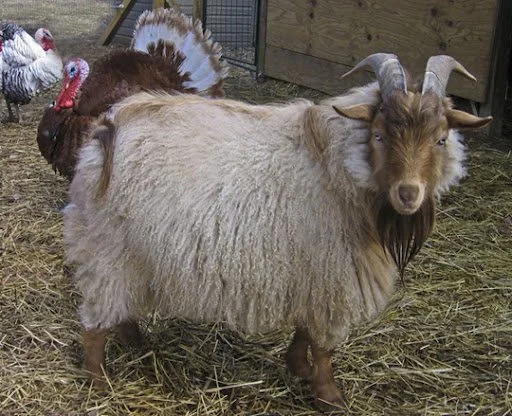
A gorgeous Nigora goat - an excellent example of the breed standard. Can you imagine wearing a luscious, insulating sweater made of this fiber? They produce multiple fiber types, often a blend of mohair and cashmere known as “cashgora”. And just think of the yogurt and chevre! With strong Nigerian Dwarf genetics, Nigora goats can produce up to two quarts of milk per day and enjoy up to 10% butterfat - top tier!
A second high tunnel also makes a LOT of sense for us. More shoulder season + winter growing; more plant starts for our customers; a protected space for propagating trees and woody perennials; getting a jump-start on spring seed starting without reducing the chooks’ room to roam indoors when there’s still snow on the ground...it would all be a win-win situation.
The problem? These goals require quite a bit of money we don’t have, and that we cannot borrow. (We already can’t afford health insurance, so if someone chimes in and suggests a low-interest loan...so help me gods...don’t get me started.) This project-based financial need is why we’ve been planning to connect with our awesome local USDA Service Center to finally get an FSA number this season. An FSA number would have made us eligible for NRCS and EQIP conservation grants + other programs to get assistance with fencing, another high tunnel, riparian buffer protection, stream bank restoration, and all the things that would let us bring these awesome animal + plant resources to ourselves and our community years sooner than we can fund them alone. We’ve been holding off on this because we weren’t near the revenue threshold to be considered an official Small Farm Operation by the state of Vermont - the point at which claiming “farmer” status would stop feeling presumptuous and start feeling like we’d earned it - but now we’re on track to meet and even exceed it. Yay for us, right? All systems are a go…right?
But then, about a week ago, I learned what the Trump administration has been planning for the USDA...and now, for the foreseeable future, those gorgeous little goats (and everything above merely paying the mortgage) is on hold.
So what, exactly, is the plan? And why TF is this happening? Well…
On April 22nd, the Department of Agriculture signed a $300 million no-bid contract with Palantir Technologies to build a unified database of American farmers. They’re calling it “One Farmer, One File.” (Reference article here.)
If you’ve heard of Palantir, you already have feelings about it; if you’re reading this, chances are good that your feelings are similar to mine - dismal. If you haven’t heard of Palantir: it’s a data analytics company co-founded by Peter Thiel - yes, the same Peter Thiel who funded JD Vance’s Senate campaign, and whose former associates now hold senior positions throughout the Trump administration. Palantir’s founding, as I understand it, was originally seeded with money from In-Q-Tel, the CIA’s venture capital arm (a phrase I should never have to write), which was built on counterterrorism intelligence work after 9/11 (see this article for more info). The company is named after the all-seeing stones in Lord of the Rings. These stones cannot lie but they can corrupt and hollow out their users with incomplete, worst-case-scenario visions of distant things, driving their users to madness, despair, greed, and a desire for dominion.
Peter Thiel chose that name deliberately. I find that clarifying…and terrifying.
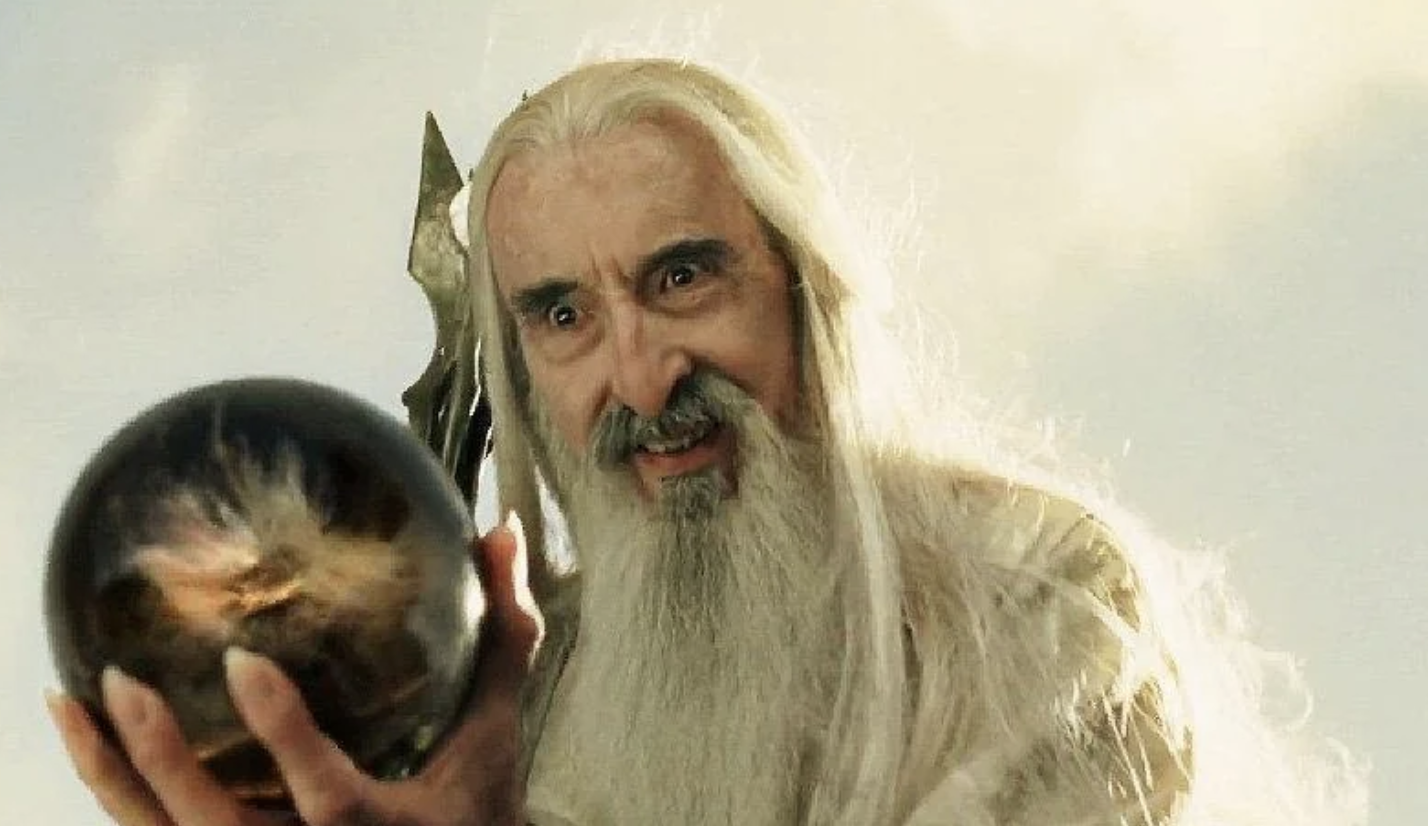
Saruman, a dominion-hungry wizard, greedily gazing into a palantir stone in LoTR. Image courtesy of reddit user Natan 3319.
Since its counterterrorism origins, Palantir has expanded into domestic surveillance with considerable enthusiasm. It holds a $30 million contract with ICE to build something called ImmigrationOS, an AI platform designed to identify, track, and deport suspected noncitizens, which prompted protests in American cities and a letter-signing campaign from more than 200 of Palantir’s own engineers. (Reference this article and this article for more info.)
(Engineers, even ones working for a technofascist overlord, apparently have limits.) Palantir also has contracts with DHS, the Pentagon, and the Department of Veterans Affairs. The USDA deal makes Agriculture the 27th federal agency to bring Palantir inside its infrastructure, bringingthe amount of federal money spent on Palantir to over $1.3 billion.
This is the company now tasked with building the American farmer database.
“One Farmer, One File” basically works like this: by 2028, every farmer who participates (or has already participated) in USDA programs - FSA loans, NRCS conservation work, crop insurance through the Risk Management Agency - will have a unified digital profile in Palantir’s Foundry system. (Reference this article and this article for more info.) Land holdings, conservation practices, financial history, insurance claims - all of it - integrated, in one place. The USDA justified the no-bid contract by arguing that Palantir is the only vendor with the existing federal accreditations and system integrations to meet the timeline. Competitors can file protests…but the contract proceeds in the meantime.
Now…this is where I want to take a moment to think out loud rather than just editorialize in private, because an honest version of this article requires acknowledging what the contract’s defenders get right. (And no, I’m not about to advocate for Palantir - but just hear me out here.)
The USDA’s IT infrastructure has been a genuine mess for decades. Maybe it has never been good enough, or even good, period. Even as a youngster, I recall my best friend’s father - a dairy farmer with a penchant for day trading on his rare rural dial-up internet connection in the ‘90s - rubbing his eyes and massaging his temples whenever the USDA was even mentioned at the dinner table. The FSA,NRCS, and the Risk Management Agency have all run their own legacy systems, and a farmer enrolled in more than one federal program has historically had to file similar paperwork multiple times in separate offices that usually couldn’t communicate with each other. (This is the kind of bureaucratic dysfunction that would be almost funny if it weren’t happening to people trying to manage a farm. Who TF has time for that?)The people staffing those county offices, for what it’s worth, are mostly people who care deeply about the farmers they serve. Many of them are farmers or from farm families themselves. (I bring this up so you know that the problem is structural, not personal). And when the Palantir-powered Landmark platform helped roll out the Farmer Bridge Assistance Program in February, it processed 35,000 farmer sign-ups in 62 minutes and delivered $4.4 billion in payments within five days. For farmers waiting on disaster relief, that kind of speed is meaningful - hell, it’s almost a miracle. If I were impacted by that, I would have wept tears of relief and joy. The bureaucratic problem underneath this contract very much exists - and we should solve it, if we care about farmers as we claim to do. But not like this.
The official framing of the Palantir deal leans on another real concern: China’s purchase of US farmland near military installations has attracted documented bipartisan attention in Congress. “Farm security is national security,” the official press release reads. “Protecting America’s farmland is protecting America itself.”
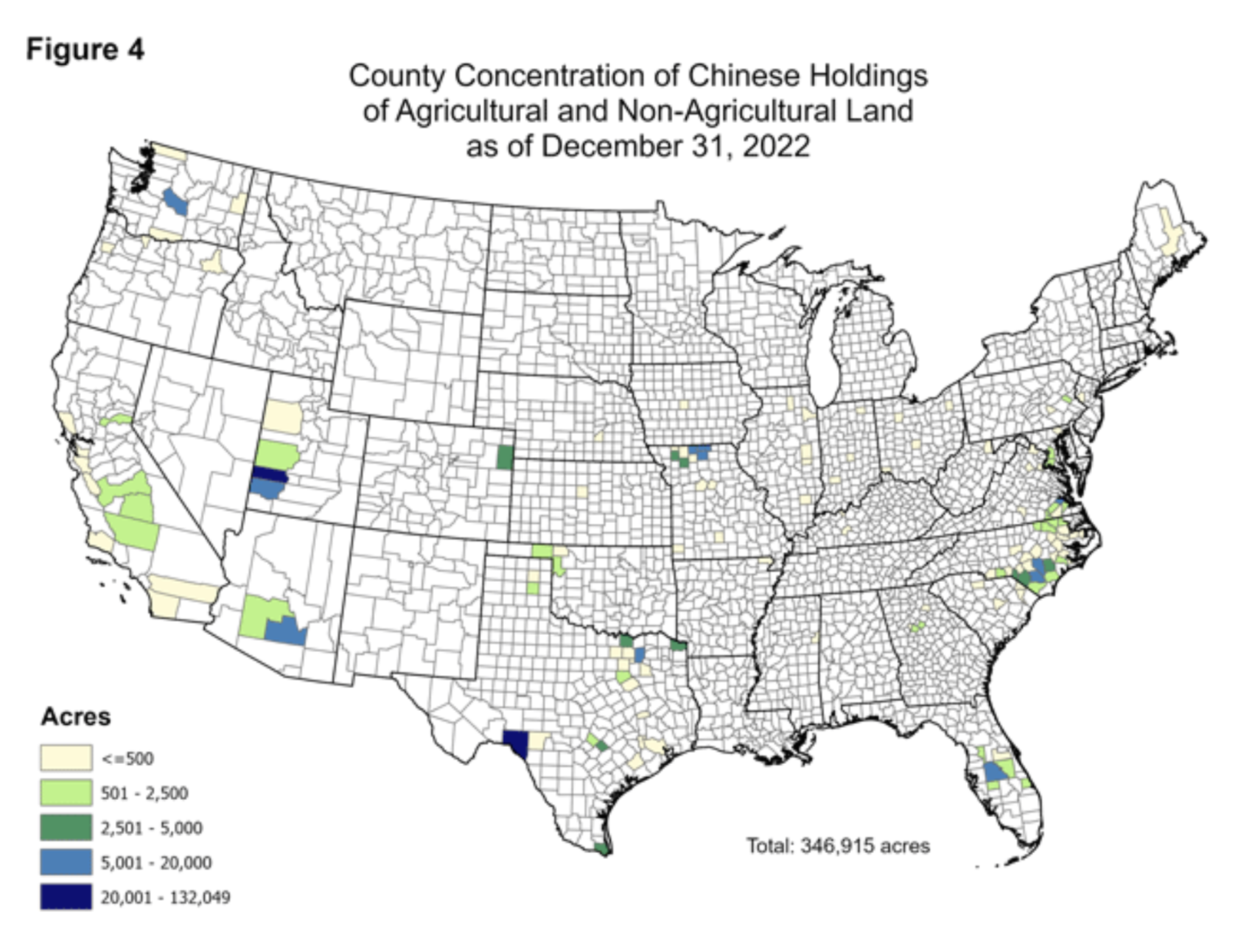
A map showing the concentration of Chinese ownership of agricultural land from a 2022 USDA report. The USDA reports that 85% of those acres are concentrated in Texas, North Carolina, Missouri, Utah and Virginia, though notable concentrations are also present in Florida, California, and Washington state. Source: https://www.dtnpf.com/agriculture/web/ag/blogs/ag-policy-blog/blog-post/2024/01/02/citing-china-missouri-governor-ag
I don’t think everyone who signed off on that language is lying - at least, not intentionally. Personally, I do think that farm security is national security. I do think that protecting America’s farmland is protecting America itself. The real problem here is what’s been bundled together under the guise of buzzy marketing speak about national security and protecting farmland…and who is carrying that bundle. A database designed to track foreign land purchases near military bases would look pretty different from a comprehensive digital profile of every American farmer’s conservation practices, loan history, insurance claims, and more. Both things are in this contract but only one of them serves the stated rationale. That gap between what’s being sold and what’s being built is where my concern lives.
The phrase I keep returning to from the official contract language is “farm security is national security.” I want to push on that just a bit, because I think it unintentionally reveals exactly what’s being glossed over. Food security in this country is not a data problem. Whether or not this country can feed itself depends - as it always has - on whether farmers can stay on their land, afford their inputs, find fair markets for what they grow, and survive the seasons (and the policy environments) that work against them. The Trump administration spending $300 million on a surveillance contractor’s farmer database is the same administration whose tariff policies were damaging enough to require a $12 billion emergency bailout for farmers caught in the ensuing trade war. It’s also the same administration that has rounded up immigrant farmworkers - farmworkers who, frankly, have been quietly subsidizing the grocery bills of Americans for generations. It’s also the same administration whose illegal war in the Middle East has sent fertilizer and fuel costs skyrocketing. Supply chains are strained; links are weakening. The economic pressure on farms - especially small and mid-sized farms - is not getting lighter. If this administration actually cared about farms and farmers, this is not how they would show it - so this is not about securing and supporting farmland and farmers. Obviously.
The people who are actually ensuring American food security are doing it in the ground, in the seasons, and in relationship with our land and the communities we serve. That’s the mechanism of success and security - not a database, not a data company. A Palantir system doesn’t grow anything…it just catalogs the people who do, in a platform run by a company with a demonstrated history of using its databases against the populations inside them. “Farm security is national security” is a phrase that foregrounds the surveillance infrastructure and backgrounds the farmer. Given who’s building the infrastructure and who’s financially invested in it, I don’t think that inversion is accidental.
Palantir executives have said publicly that the “One Farmer, One File” data will be USDA-specific, and that it won’t be shared with other agencies. Secretary Rollins has reassured farmers that county FSA offices will stay open and that digitization isn’t mandatory. I’ll take those assurances at face value - their currency of trust dilapidated as it is - with one caveat: these promises are only as durable as their ability to resist executive orders that could change them (i.e., not durable at all). We’ve already watched the Trump administration facilitate IRS data sharing with ICE and DOGE - information that millions of Americans filed with the federal government under a longstanding implicit understanding about how it would be used. That data-sharing arrangement is currently being litigated by plaintiffs arguing it violates the Privacy Act. The litigation is ongoing…but the sharing already happened.
And it’s a documented fact - not a rumor - that Stephen Miller, the chief architect of this administration’s immigration enforcement agenda, holds a financial stake in Palantir. That conflict of interest sits uncomfortably next to any promise about what a Palantir-managed farmer database will and won’t eventually be used for. All legitimate jokes about what an evil, Nosferatu-looking anal polyp he is aside…the man cannot be trusted.
Speaking of things that cannot be trusted…I also want to note something that makes me a bit uncomfortable with my own train of thought on this topic: there is a version of this kind of thinking that tips into tinfoil-hat territory, and I don’t want to go there. I’ve spent enough time in counter-extremism research and advocacy to know how quickly legitimate concern can curdle into conspiratorial pattern-matching that explains everything but proves nothing. I’m also aware that we’re living through a moment of heightened political anxiety that makes everything look sinister - perhaps even more sinister than it really is. I’m trying to account for that in my writing these days, while also not dismissing concerns that could materialize into the monsters I dream about with increasing frequency these days…
…but here’s where my anxiety gets harder to dismiss. We’ve been thinking about formalizing our farmstead under an LLC (good standard practice for any business, perhaps especially a food business) because legal protections matter in our litigious age. But what I can’t stop turning over in my mind is this: if we register as a farm entity and file a Schedule F with the IRS (the standard federal form that declares you a farmer to the federal government), then we’ve put ourselves on a federal agricultural data trail. Given that we already know this administration opened an IRS-to-ICE data pipeline, the question of whether a Schedule F declaration could eventually find its way to a Palantir system and put us in the “One Farmer, One File” database is not one I can fully dismiss. It’s one thing for us to talk about our farmstead on the internet; it’s quite another for us to declare it in an AI-database-friendly way to the government.
To be clear: I cannot document that pathway, and maybe that’s because it doesn’t exist yet…but it could…and maybe it already does and we just don’t know it. It’s a chain of plausible what-ifs, not an established fact. BUT, only two years ago, I would have called IRS-to-ICE data sharing a paranoid hypothetical…and here we are watching it get litigated. The line between reasonable concern and Orwellian catastrophizing keeps moving, and it keeps moving in one direction - the bad one. So, please know that I bring up the LLC question not because I have an answer, but because I suspect I’m not the only small farmer who was on the verge of formalizing their operation but will now lose sleep over this instead of celebrating the feeling of being the real deal.
What I can say with confidence is that the documented facts alone - the no-bid contract, Palantir’s track record, Stephen Miller’s conflict of interest, the IRS/ICE data-sharing precedent - are more than enough to justify serious concern, even before anything speculative or tinfoil-hat-y enters the picture.
So, all of this to say: we haven’t applied for an FSA number and until something changes, we won’t…and I know we’re not alone in our concerns. This holds up progress, food security, and economic abundance for us and for our community. We probably won’t even file for an LLC, as much as we want that layer of legal protection. We were waiting until we’d genuinely crossed Vermont’s Small Farm Operation threshold because it felt wrong to try to claim the “farmer” status before we’d really earned it. We’re there now. We’re ready. The folks at our local USDA Service Center were going to be the next phone call.
But now, that call is on hold, indefinitely - and so, so is the funding eligibility that would have let us advance our community-scale regenerative farmstead at a time when food scarcity and supply chain fragility means we all need it most. The goat fencing, the stream bank restoration, the invasive species remediation, and the second tunnel will happen eventually…they’ll just have to come entirely out of pocket, which means they’ll come years later than they otherwise would have. What that means in practice: our community will wait longer for the hyper-local dairy supply it wants and - given the ongoing deterioration of supply chain conditions and rising food prices - increasingly needs. It means that folks who would have bought plant starts from us next spring to increase the biodiversity and food resiliency of our neighborhood either won’t get those starts, or will spend their money outside of our immediate community. It means we can’t expand our flock of laying hens. It means we can’t breed rabbits for meat and fur. It means that our stream bank will further undercut itself with each summer flood. It means that we have to hope supply chains don’t collapse and climate change doesn’t worsen before we can bring these operations online for ourselves and our community.
Sure, these aren’t catastrophic losses and delays - we still raise chickens, sell eggs, and are bringing vegetable and herb sales online this summer, and of course we both have our off-farm jobs like most farmers do - but they are notable losses and delays, especially in terms of food security. And Vermont is known for our dairy farms, but more close each year due to thin margins and retiring farmers with no one to take the reigns. With that said, despite being a dairy-loving state, I couldn’t tell you where to get a gallon of organic pasteurized milk within 20 miles of me (though that may be my own fault - not the market’s). More than once in the past six months, I’ve gone to buy milk and found empty shelves with a note about there being an organic dairy shortage - in Vermont! I think this goes to show that if the collective “we” waits until the moment of need for food sovereignty, then we’ll all be too late to have it. That’s why not being able to access these incredible USDA grant programs will hurt us and folks like us so much - the enemy is already at the gates. We all need functional, hyper-local micro-dairies and established nut groves and strong stream banks and plant nurseries and healthy orchards and abundant chicken flocks like yesterday. These are the kinds of losses, delays, and considerations that are causing quiet, cumulative catastrophe across hundreds of small American farms making the same calculations that we are.
And of course, I’d be remiss if I didn’t mention this: I highly doubt that MAGA-aligned farmers care about any of this - even the most libertarian among them probably aren’t willing to safeguard their liberty at the cost of their grants and subsidies. Many of them can’t afford to even if the friction of it keeps them up at night - they’d lose the family farm. What does that mean? That the upcoming generation of liberal and leftist farmers with TBD USDA status will be the ones getting left behind as we refuse to bend the knee to technofascist overlords who seek to control not only Americans’ health, wealth, and safety - but also our farmland and food supply.This will have implications for generations to come - and the implications are not good.
Vermont’s agricultural and rural policy organizations haven’t said much about this contract yet, and I understand why. Rural Vermont and NOFA-VT are both consumed right now by the urgent fight over municipal zoning exemptions for farms and and Act 181. I understand that - I’ve been on some of the policy calls, and I heartily thank these orgs for their priceless, tireless service. We’re also coming to the close of the official legislative session, so urgency abounds. It’s also planting season, and lambing/kidding/calving season - we’re busy out here. Once spring comes to Vermont, every hour between sunrise and sunset is a precious sprint to do as much as you can before winter, because winter is never that far away. Growing as much food as possible feels matched in urgency only by passing good local and state legislation while the season is in session. But if you’re a Vermont farmer who has enrolled in USDA grant programs in the past, please know that your data is already in a system that as of last week Palantir’s infrastructure can now touch.
And for us new farmers…well, I wish us the best of luck. We’ll need all we can get.
I’d like this conversation to kindle and catch fire in Vermont’s agricultural community, and in farming communities everywhere. So if you’re farming, or farming-adjacent, or just paying attention to where all of this is going: what are you thinking? Are you weighing any of this for your own operation? I genuinely want to know. I hope you’ll share this article, sound off in the comments, and reach out to me if you want to have deeper conversations about it in a collaborative, public way for the benefit of farmers everywhere.
Farm security isn’t just national security - it’s food security, economic security, existential security, human security, cultural security. More than steak is at stake.
The future belongs to those who feed it - and it’s a future worth protecting.