Many of us in America today feel that we’re at an inflection point of sorts: political, environmental, economic, social, domestic…the list of ways we’re seeking a better direction could fill this post and then some. But how are we to approach this disjointed-yet-collective project? Well…my special interest is utopias, so I’m of the mind that an essential piece of this puzzle is to study them. If we can learn from American utopian history, hopefully we can repeat the parts that worked and scrap the ones that didn’t.
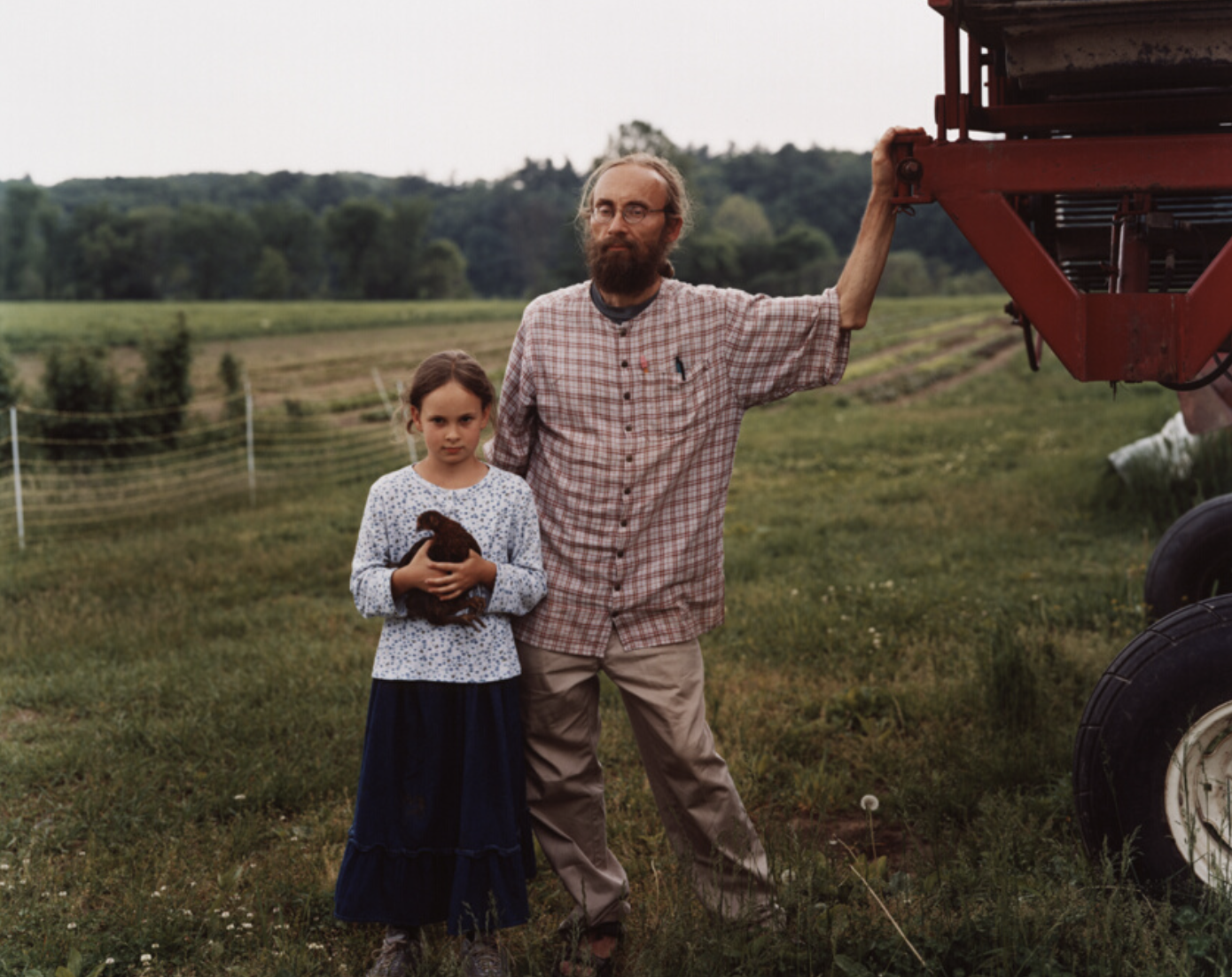
Twelve Tribes Community, Basin Farms, Bellow Falls, Vermont. Chromogenic print by Joel Sternfeld, from the series "Sweet Earth: Experimental Utopias in America". Image produced in 2005.
Vermont is obviously central to this conversation. Few places have as well-earned a reputation as an historic hotbed of counter-cultural and communal living. Between 1968 and 1974, there were as many as 75 active communes in our Brave Little State. Though the vast majority of them have sunset, they left behind them a legacy of green energy, community gardens, food coops, alternative schools, art collectives, and women’s networks. But…why Vermont? Our verdant land and iconic agricultural reputation may have drawn the counter-culturalists here, sure…but why did they take root so well, and leave behind such a profound utopian legacy?
In a 1983 edition of the Sunday Rutland Herald and Times Argus, Reporter Yvonne Daley made a statement that will surprise no Vermonter today: that Vermonters in the 1960s and ‘70s were mostly accepting of counterculture movements because those Vermonters were (as we are still today) rather anti-authoritarian by nature…so culturally, we’re quite accepting of radical groups and free thinkers.2
Below are five very distinct utopian projects with roots in Vermont.
The amount of research about these projects cannot be overstated (it’s a lot), so what you’re seeing here are the cliff’s notes - just enough to whet your appetite for more. Along with each utopian project, I’ve included contextual information from one of my favorite websites, vermonthistory.org. In some cases, I’ve also peppered in some additional listening (podcast format) or reading.
As you look into these, I hope you’ll make note of what elements of each utopian project appeal to you for present-day application. Likewise, take note of what doesn’t speak to you - that’s just as key.
John Humphrey Noyes’s Perfectionists originated in Putney, VT. They eventually moved to Oneida, New York where they became one of the more famous American utopian projects: the Oneida Colony. Yep - fine flatware makers, the very same. If you’d like an in-depth listen about how this polyamorous utopian project became an iconic symbol of middle-class domesticity, you can listen to one of my favorite podcasts ever: Nice Try! Season One is all about utopias, and the episode about the Oneida Colony is one of my faves.
Quarry Hill in Rochester, VT was the first commune in Vermont, but didn’t see itself as a commune. It was one of the first communes where men were actively involved in child rearing. A home study course at Quarry Hill, run by Sue Geller, became a model for other alternative schools. You can learn more about Quarry Hill through this Vermont Public article and this article from VermontHistory.org.
Total Loss Farm in Guilford, VT is one of the enduring communes and perhaps the most successful. Established in 1968, the commune survived the difficult early years with money earned from writing. Home Comfort: Stories and Scenes of Life on Total Loss Farm, (1973) was a compilation of poems, vignettes, autobiographical sketches, practical advice, recipes, and literary miscellany written by twenty-five permanent and occasional members of the commune. The Body’s Symmetry (1970) by Veranda Porche, was a collection of her poems. Ray Mungo’s book, Total Loss Farm: A Year in the Life (1970) was yet another book that brought notoriety and income to the commune. It is worth noting here that Veranda is a fabulous poet; I’ve had the pleasure of listening to her read from her works and in them, I can hear echoes of another time.
The New Hamburger Commune in Plainfield formed in 1970 from two separate communes. It achieved some notoriety by establishing a cooking and catering business. In 1975, when an article appeared about them in the food section of the Free Press, the commune consisted of seven men, four women, and two children. Located outside Plainfield village, the commune owned 85 acres of land on which were four dwellings and a main house. Members of the commune raised their own fruits and vegetables, did cooking and catering of vegetarian foods, had recently set up a cannery that produced unsweetened apple sauce and apple butter, and even taught a course on “the politics of food” at Goddard College during the summer of 1975.
The Twelve Tribes. Call them famous, call them infamous…both their flourishing and their infamy is rooted in Vermont’s Northeast Kingdom region. Founded in Tennessee in the early 1970s, the group’s modern history began in 1977, when several hundred members moved far north to Island Pond, VT and took the official name ‘Northeast Kingdom Community Church’. Opposition occurred almost immediately. At the center of the controversy surrounding the group was their belief in the corporal punishment of children.
The story of the Twelve Tribes is a complex one. In Vermont, it involved a pedophile being killed by his own mother; a state police raid on members’ homes, resulting in the seizure of 112 children; and - later - “unequivocal evidence of a campaign to manufacture and disseminate misinformation about the group,”. When the matter came to court and no evidence of abuse was found, the children were returned to their parents. Despite this, an aura of suspicion and mistrust has plagued The Twelve Tribes for decades. (More info on that here.)
The Twelve Tribes has several outposts of a restaurant called The Yellow Deli, two of them still here in Vermont. As a teenager in Chattanooga, TN, I personally remember my father telling me that he didn’t care how much I liked the yerba maté and lamb sandwiches at Chattanooga outpost of The Yellow Deli - he didn’t want me anywhere near it. I was told in no uncertain terms that the yerba maté, delicious food, and nice-hippie vibe was how they ‘seduced’ teenagers into joining their ‘cult’. For the record, no one ever asked me to join; the closest evidence of recruitment was flyers advertising monthly gatherings at their farm. However, I do know a handful of young folks who were disenfranchised by the recession of 2008, and their tenuous finances and unstable living situations made them more susceptible to recruitment by The Twelve Tribes. Also for the record, though, that yerba maté and those lamb sandwiches are worthy of cult following…just not literally.